Introduction
In early September 2026, India moved forward on two ocean-related fronts: the launch of a new research vessel and continued work on seabed minerals. Both point to a larger theme that students of current affairs cannot ignore—the Blue Economy.
This is not only a news item. It sits at the meeting point of economy, science and technology, international law and environmental policy. A student who understands the idea, the programmes behind it, and the limits of what India has actually achieved so far can write a clearer Prelims note and a more balanced Mains answer.
Meaning of Blue Economy and Its Scope in India
Blue Economy means using ocean and coastal resources for economic growth, jobs and livelihoods while trying to keep marine ecosystems healthy. It is wider than fisheries. It includes ports and shipping, coastal tourism, marine biotechnology, offshore energy, desalination, research, logistics and, increasingly, minerals on the seabed.
India has a long coastline of about 11,098 km and an Exclusive Economic Zone of more than 2 million square kilometres. For years this space was treated mainly as a fishing zone plus a few major ports. That view is changing. Estimates commonly place the Blue Economy at around 4% of GDP. Different officials have spoken of raising that share over time—some have mentioned about 8% by 2030, while maritime-policy discussions have also spoken of a higher share by 2047. These figures should be treated as stated ambitions, not as a single notified national target.
When you write an answer, treat Blue Economy as a connecting idea. It helps you bring fisheries, ports, research ships, climate data and seabed minerals under one heading without forcing the phrase into every sentence.
Why India is Paying More Attention Now
Three pressures are working together.
First, India wants more growth and jobs from the coast and the sea. Fishing communities already depend on the ocean. Shipbuilding, ports, logistics, tourism and research can add to that base.
Second, the energy transition needs metals such as nickel, cobalt, copper, manganese and rare earths. These are important inputs for batteries, electronics and several clean-energy technologies. India still imports a large share of them. China has a dominant position in the processing and refining of several critical minerals. That makes supply security a policy concern.
Third, weather, cyclones, sea-level changes and monsoon patterns can be better understood and monitored with improved ocean data. Research vessels, sensors and maps are not only scientific tools. They are also tools of disaster preparedness.
These reasons explain why the government is spending on research ships, submersibles and seabed surveys. The Blue Economy is the wider frame. Deep-sea mining is one debated part of that frame.
Deep-Sea Mining and How It Links to the Blue Economy
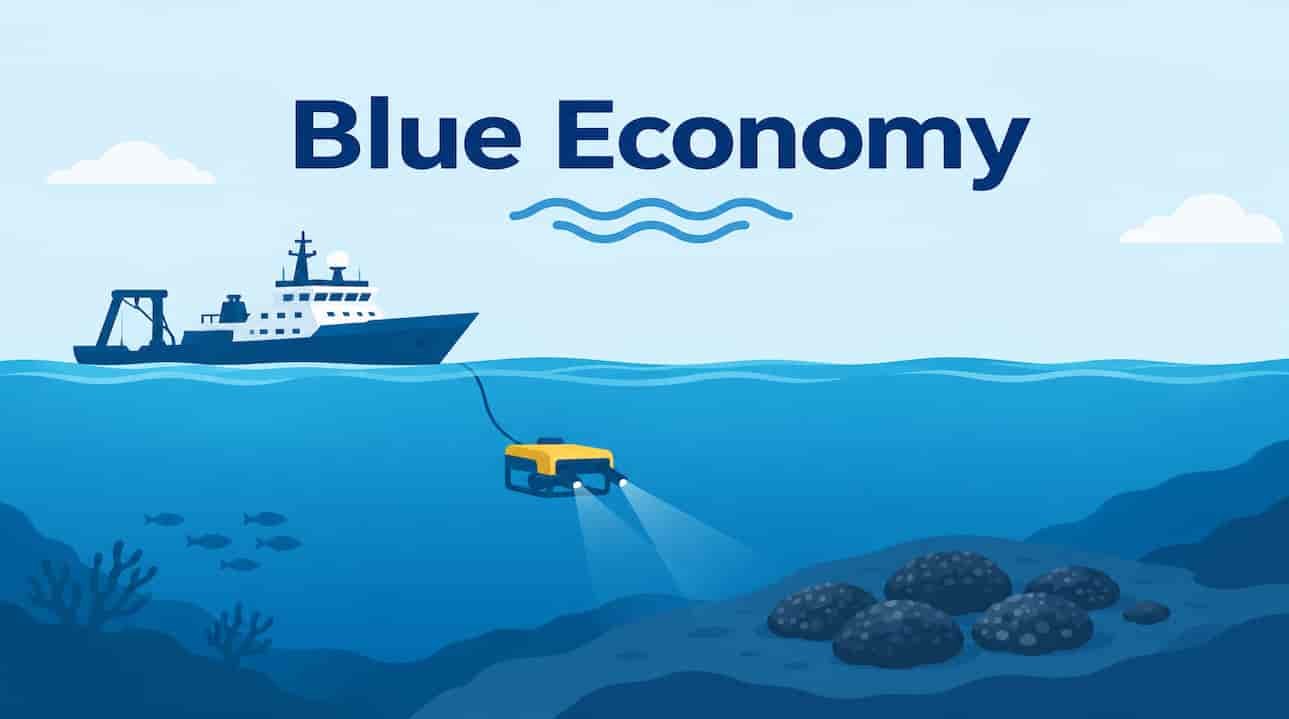
Deep-sea mining means collecting mineral-rich deposits from the ocean floor, often at depths of 4,000 metres or more. Two deposits matter most for India.
Polymetallic nodules look like dark, potato-shaped lumps on the abyssal plain. They contain manganese, nickel, copper and cobalt. Polymetallic sulphides form around hydrothermal vents and can be richer in copper, zinc, gold and silver.
Do not confuse exploration with mining. India has exploration contracts. Commercial mining has not started. That distinction is one of the most useful points a student can remember.
Officials often link deep-sea mining to the Blue Economy because the same ocean system also needs ships, ports, research, environmental baselines and industrial capacity. Minerals are only one possible output.
Deep Ocean Mission
The Deep Ocean Mission was approved in 2021 with an outlay of about Rs 4,077 crore. The Ministry of Earth Sciences is the nodal ministry. The mission has several verticals. For exams, these are the most useful:
- a manned submersible, Matsya-6000, designed to operate at up to 6,000 metres
- technology for collecting nodules from the seabed
- deep-ocean survey and exploration
- work on climate services, biodiversity and ocean-based energy or freshwater
Progress has been mixed. Parliamentary scrutiny has earlier pointed to slow spending in the initial years. At the same time, hardware tests have taken place. NIOT has conducted mobility and system-powering trials of a deep-sea mining machine at about 5,270 metres in the Central Indian Ocean. Matsya-6000 has undergone trials in shallower and controlled conditions, while its full deep-sea capability is still being developed. Full commercial mining capability is still a future goal, not a present fact.
A balanced answer should say that the mission exists, some technology has been tested, and commercial extraction remains distant.

Latest Development: Launch of ORV Sagar Manthan
On 9 September 2026, Garden Reach Shipbuilders & Engineers launched ORV Sagar Manthan at the Rishi Bankim Shipyard in Kolkata. The vessel is being built for the National Centre for Polar and Ocean Research under the Ministry of Earth Sciences. According to the official briefing, it is being constructed under Vertical-4 (Deep Ocean Survey and Exploration) of the Deep Ocean Mission at an approximate cost of Rs 840 crore.
The ship is about 89.5 metres long and 18.8 metres wide, with a gross tonnage of about 5,900 tonnes. It is designed as an all-weather platform, including for work in extreme environments such as the Southern Ocean. After delivery, it is expected to support multibeam and geophysical seismic surveys in coastal and deep waters, including operations at depths of up to 6 km, and to deploy remotely operated and autonomous underwater vehicles. Delivery and commissioning are expected around 2028.
In the official launch remarks, the Earth Sciences Minister said the new vessel would gradually replace the 43-year-old ORV Sagar Kanya, which India procured from Germany in 1983. That is an official statement about the intended role of the new ship. It does not mean Sagar Kanya has already been retired.
This launch is useful for two reasons. It is a 2026 current-affairs fact. It also shows India trying to build advanced research platforms at home instead of depending only on imported vessels.
India’s Exploration Rights and Critical Minerals
The International Seabed Authority has contracted India an area of 75,000 sq km in the Central Indian Ocean Basin for exploration of polymetallic nodules. Government replies to Parliament have estimated the nodules in that area at about 366 million metric tonnes on a dry-weight basis. Older Ministry of Earth Sciences briefings have used a figure of about 380 million tonnes. Students should remember the range and the source difference, not treat one number as sacred.
India also holds an ISA contract for exploration of polymetallic sulphides over 10,000 sq km along parts of the Central Indian Ridge and South-West Indian Ridge. India has later sought additional exploration work, including in the Carlsberg Ridge area. These are exploration rights under international seabed law. They are not a licence to start commercial mining tomorrow.
The ISA is still working on the rules for exploitation, often called the Mining Code. Until those rules are settled, large-scale extraction in areas beyond national jurisdiction remains legally unfinished business.
Inside India’s own Exclusive Economic Zone the legal position is different. Even there, technology, cost and environmental rules remain difficult. An earlier attempt to auction some offshore mineral blocks did not attract enough serious bids and was cancelled. That is a useful reminder that interest on paper is not the same as commercial readiness.
Opportunities
If technology, law and environmental safeguards move together, the possible gains are clear.
Seabed minerals could, over a long period, reduce some import dependence in critical metals. Shipbuilding, underwater vehicles and survey systems can create a specialist industrial base. Better maps and ocean data can help shipping, fisheries management and cyclone warning. Coastal states can gain research and service jobs if the work is not limited to a few national laboratories.
There is also a diplomatic angle. Countries that understand deep-ocean science sit in a stronger position when global ocean rules are written. India wants that capacity.
None of this is automatic. Opportunity is not the same as achievement.
Challenges
The same topic has a difficult side. A good answer should include it.
The deep ocean floor is still poorly mapped. Many organisms there grow slowly and live in conditions that are easy to disturb. Mining can create sediment plumes that may spread beyond the mining site and affect deep-sea organisms and ecosystems. Several countries and scientific groups have called for caution, and some have supported a pause until more evidence is available.
Technology is expensive and still unproven at commercial scale. Collecting nodules at around 5,000 metres and lifting them with limited harm to the site is not ordinary industrial work. Indian private firms have so far been cautious.
Legal uncertainty remains because the ISA has not finished exploitation regulations. Inside national waters, coastal communities and environmental groups are likely to raise questions about livelihoods and habitat damage.
A careful student position is simple: first map, then test, then decide. Do not hide the problems, and do not pretend the minerals are already in India’s factories.

How to Use This Topic in Competitive Exams
Possible Prelims angles:
- Which mission includes Matsya-6000?
- ORV Sagar Manthan is associated with which organisation and mission?
- India has an ISA contract over 75,000 sq km for which resource?
- What is the difference between exploration rights and commercial mining?
Possible Mains angles:
- Discuss the potential of the Blue Economy for India.
- Examine the opportunities and risks of deep-sea mining.
- How can ocean resources support energy security without weakening environmental safeguards?
For Mains, try to connect Blue Economy with critical minerals, energy security, climate resilience and technology. That usually produces a broader and more balanced answer than a list of ship names and contract areas.
Way Forward
India should complete the research vessels and submersible first. Environmental baseline studies should be completed before large-scale commercial mining decisions are considered. Private industry can be invited after small-scale technology is proven, not before. At the ISA, India can protect its exploration rights while supporting clear environmental rules. Coastal communities and states should also benefit from the Blue Economy, rather than leaving the work concentrated in central government institutions.
Conclusion
India’s work on Blue Economy and deep-sea mining is not one scheme and not one ship. It is a long attempt to treat the ocean as an economic and scientific space at a time when countries are competing for minerals and climate data. The launch of ORV Sagar Manthan in September 2026 is one visible step. The Deep Ocean Mission is the larger programme. Deep-sea mining is the most debated piece inside that programme.
For a student, the useful method is to keep three layers together: the facts, the doubts, and the connections. Facts without caution sound like a press note. Caution without facts sounds vague. The Blue Economy is the heading that can hold both.
FAQs
Q1. What is the Blue Economy?
A: Sustainable use of ocean and coastal resources for growth, jobs and livelihoods. It includes fisheries, shipping, tourism, energy, research and seabed minerals.
Q2. Has India started commercial deep-sea mining?
A: No. India has exploration contracts and is developing technology. Commercial mining has not started.
Q3. What is ORV Sagar Manthan?
A: An indigenous ocean research vessel launched on 9 September 2026 by GRSE for NCPOR under the Ministry of Earth Sciences. It is being built under the Deep Ocean Mission at an approximate cost of Rs 840 crore.
Q4. Which body regulates mineral exploration in international seabed areas?
A: The International Seabed Authority (ISA), established under UNCLOS.
Q5. Why are polymetallic nodules discussed so often?
A: They contain nickel, cobalt, copper and manganese, which are important for batteries, electronics and some clean-energy technologies.
Q6. What is Matsya-6000?
A: A manned deep-sea submersible being developed under the Deep Ocean Mission, designed for operations down to 6,000 metres.
Q7. Has the government notified a Blue Economy GDP target of 8% by 2030?
A: No single Cabinet notification should be assumed from news reports alone. Officials have discussed raising the Blue Economy’s contribution from around 4% of GDP, and one senior Earth Sciences official has spoken of about 8% by 2030. Treat it as a stated ambition unless a primary policy document says otherwise.
Sources
- Press Information Bureau / Ministry of Earth Sciences: launch note on ORV Sagar Manthan, 9 September 2026
- Garden Reach Shipbuilders & Engineers (GRSE) and NCPOR briefings on the vessel
- Ministry of Earth Sciences replies in Parliament on polymetallic nodules and the Deep Ocean Mission
- International Seabed Authority: exploration-contract framework for nodules and sulphides
- National Institute of Ocean Technology (NIOT): deep-sea mining system and Matsya-6000 development updates
- NITI Aayog report on India’s Blue Economy and deep-sea/offshore fisheries (2025)
Note: Current-affairs facts and figures can change. Always check the latest official sources before using them in an exam answer.