Introduction
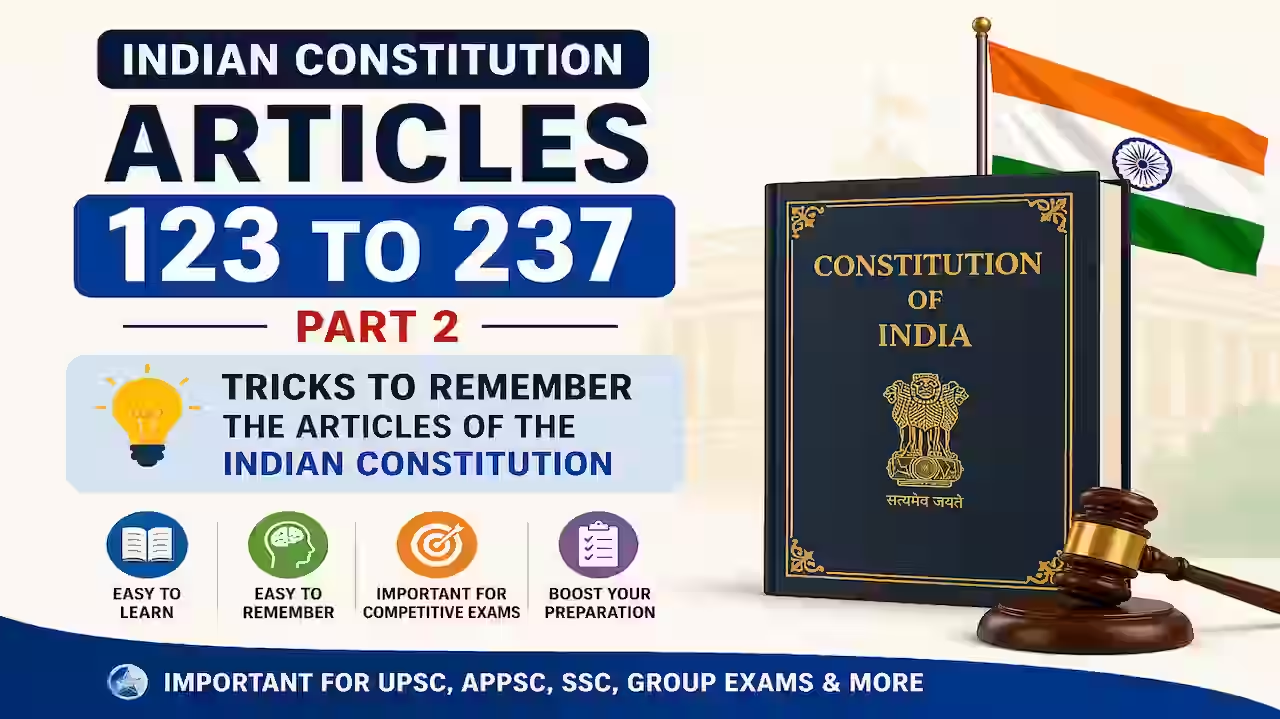
This is Part 2 of “Tricks to Remember the Articles of the Indian Constitution Part 1.” Before reading these tricks and short stories, first read the original Constitutional Articles at least once so you can understand the actual meaning and connection behind each keyword. In this part, we discussed Articles 123 to 237, covering important topics such as the President’s Ordinance Power, Supreme Court, Governors, State Legislature, High Courts, Judicial Services, and Legislative procedures. These Articles are very important for competitive exams like UPSC, APPSC, SSC, Group exams, Judiciary, and other government exams because questions are frequently asked from Constitutional Articles, amendments, powers, qualifications, and important cases.
To make learning easier, I created simple story-based keyword tricks under the title “Tricks to Remember the Articles of the Indian Constitution.” The highlighted trick words help you quickly connect the article number with its main subject and revise faster during exams. This method is especially useful for remembering confusing Articles in Polity without byhearting everything line by line. First understand the Article, then learn the trick word, revise regularly, and connect similar Union and State Articles together for better memory and quick recall in examinations.
Tricks to Remember the Articles of the Indian Constitution
Part 5: The Union (Articles 123–151) Continuation
I have given a small story to remember from 123 to 151, and the highlighted words in the story are the article words. From that, you can remember what each article tells. This story is created by me.
Small Story:
To Promote Ordinary Estate worker Salary and Appointment or Temp Appointment are simple. Retired fund also given because we follow High Value work, but currently there is one Position is there and person need to Handle everything about work. If you have any Doubt you can ask manager for solution and Personal Doubts also, and can also discuss Newspaper News. First Manager Give Time then only you can ask. Should adopt to Modern Technology. Manager Has Power to check your work. Manager can correct Previous Work. Manager powers can be Increased. Manager can Tell Rights. You can withdraw Amount once amount is credited. Worker Has Some Powers to make rules so everyone should follow. He can make Any Law to complete work. Anything goes wrong, if you have any Doubt you can ask manager.
He make Everyone Helps you completing work. Now Rules Of Manager: he can Appoint Anyone so no one can Interrupt. He Audit the work process. Also assigns Different Duties and Create Accounts and Create Reports.
Article 123
- Subject/Topic: Legislative power of the President to promulgate Ordinances.
- Key Provision: The President can issue laws when Parliament is in recess to handle urgent matters.
- Part of Constitution: Part V (The Union) – Chapter IV.
- Related Amendments:
- 38th Amendment (1975): Made President’s “satisfaction” non-justiciable.
- 44th Amendment (1978): Reversed the above; made the satisfaction of the President open to judicial review.
- Important Features: Same force as an Act of Parliament; temporary in nature.
- Exceptions/Limitations: Cannot be used if both Houses are in session; cannot amend Fundamental Rights; must be approved by Parliament within 6 weeks of reassembly.
- Related Articles: Article 213 (Governor’s Ordinance power).
- Important Cases: D.C. Wadhwa v. State of Bihar (1987) – Ruled that “re-promulgation” of ordinances is a fraud on the Constitution.
- Keywords: Recess, Immediate Action, 6 Weeks, Reassembly.
- Articles in News: Discussion on the frequent use of ordinances for economic reforms.
- Special Facts: Longest possible life of an ordinance is 6 months and 6 weeks.
- Trick Word: Promote Ordinary
Article 124
- Subject/Topic: Establishment and Constitution of the Supreme Court.
- Key Provision: Forms the Supreme Court and sets rules for judge appointments and removals.
- Part of Constitution: Part V (The Union) – Chapter IV.
- Related Amendments:
- 99th Amendment (2014): Introduced NJAC (National Judicial Appointments Commission).
- null (Note: NJAC was later struck down as unconstitutional by the SC).
- Important Features: Judges are appointed by the President; Retirement age is 65.
- Exceptions/Limitations: A judge can only be removed on grounds of “proved misbehavior or incapacity.”
- Related Articles: Article 217 (High Court Judges), Article 121 (Restriction on discussion in Parliament).
- Important Cases: Supreme Court Advocates-on-Record Association v. Union of India (Second and Fourth Judges Cases) – established/protected the Collegium System.
- Keywords: Collegium, Removal (Impeachment), 65 years, Distinguished Jurist.
- Articles in News: Debates on increasing the number of judges to reduce case pendency.
- Special Facts: No minimum age is mentioned for becoming a Supreme Court judge.
- Trick Word: Estate
Article 125
- Subject/Topic: Salaries, etc., of Judges.
- Key Provision: Parliament determines salaries, which are protected from being reduced.
- Part of Constitution: Part V (The Union).
- Related Amendments: 54th Amendment (1986): Allowed Parliament to set salaries via law rather than constitutional amendment.
- Important Features: Charged upon the Consolidated Fund of India (not voted on).
- Exceptions/Limitations: Salaries can be reduced only during a Financial Emergency (Article 360).
- Related Articles: Article 360 (Financial Emergency).
- Important Cases: null
- Keywords: Consolidated Fund, Salaries, Financial Emergency.
- Articles in News: null
- Special Facts: Guarantees judicial independence by ensuring financial security.
- Trick Word: Salary
Article 126
- Subject/Topic: Appointment of acting Chief Justice.
- Key Provision: President appoints an acting CJI when the office is vacant or the CJI is absent.
- Part of Constitution: Part V (The Union).
- Related Amendments: null
- Important Features: Only a sitting SC judge can be appointed as acting CJI.
- Exceptions/Limitations: null
- Related Articles: null
- Important Cases: null
- Keywords: Vacancy, Absent, President Appoints.
- Articles in News: null
- Special Facts: Ensures the “Court never sleeps” and leadership is always present.
- Trick Word: Appointment
Article 127
- Subject/Topic: Appointment of ad hoc Judges.
- Key Provision: Temporary appointment of High Court judges to the SC if there is no Quorum.
- Part of Constitution: Part V (The Union).
- Related Amendments: null
- Important Features: CJI makes the request with the President’s consent.
- Exceptions/Limitations: The HC judge must be qualified to be an SC judge.
- Related Articles: Article 128.
- Important Cases: null
- Keywords: Quorum, Ad hoc, HC Judge.
- Articles in News: Used recently to tackle the massive backlog of cases.
- Special Facts: Ad hoc judges have the same jurisdiction and powers as regular SC judges.
- Trick Word: Temp Appointment
Article 128
- Subject/Topic: Attendance of retired Judges at sittings of the Supreme Court.
- Key Provision: CJI can invite retired SC or Federal Court judges to sit as judges for a short period.
- Part of Constitution: Part V (The Union).
- Related Amendments: null
- Important Features: Requires the consent of the retired judge and the President.
- Exceptions/Limitations: A retired judge sitting under this article is not deemed a regular judge of the SC.
- Related Articles: null
- Important Cases: null
- Keywords: Retired Judge, Consent.
- Articles in News: null
- Special Facts: This is a rarely used provision aimed at clearing specific backlogs.
- Trick Word: Retired
Article 129
- Subject/Topic: Supreme Court to be a Court of Record.
- Key Provision: SC records are high-value evidence; SC has the power to punish for Contempt.
- Part of Constitution: Part V (The Union).
- Related Amendments: null
- Important Features: Power to punish for contempt extends to both “civil” and “criminal” contempt.
- Exceptions/Limitations: null
- Related Articles: Article 142 (Complete Justice), Article 215 (High Court as Court of Record).
- Important Cases: In re: Arundhati Roy (2002); Prashant Bhushan Case (2020).
- Keywords: Court of Record, Contempt, Permanent Memory.
- Articles in News: Frequent discussions regarding the limits of “Criminal Contempt” vs. Free Speech.
- Special Facts: The SC can punish for contempt of itself and for contempt of sub-ordinate courts.
- Trick Word: High Value
Article 130
- Subject/Topic: Seat of Supreme Court.
- Key Provision: Specifies Delhi as the seat but allows for other locations.
- Part of Constitution: Part V (The Union).
- Related Amendments: null
- Important Features: CJI has the power to appoint other seats with the President’s approval.
- Exceptions/Limitations: It is a discretionary power; no court can compel the CJI to set up a bench elsewhere.
- Related Articles: null
- Important Cases: null
- Keywords: Delhi, Seat, CJI Discretion.
- Articles in News: Strong demands from South Indian states for a Regional Bench in Chennai or Hyderabad.
- Special Facts: Optional “Circuit Benches” can be established under this Article.
- Trick Word: Position or Seat
Article 131
- Subject/Topic: Original Jurisdiction of the Supreme Court.
- Key Provision: The SC handles “Federal Disputes” (Center vs. State or State vs. State).
- Part of Constitution: Part V (The Union).
- Important Features: This is Exclusive Jurisdiction—no other court can hear these cases.
- Exceptions/Limitations: Does not apply to inter-state water disputes (Art 262) or Finance Commission matters.
- Related Articles: Article 262 (Water Disputes), Article 280 (Finance Commission).
- Important Cases: State of Karnataka v. Union of India (1978).
- Keywords: Federal Dispute, Exclusive, Original.
- Articles in News: States challenging Central laws like CAA or Farm Laws under Article 131.
- Special Facts: This article protects the federal structure of India.
- Trick Word: Handle
Article 132
- Subject/Topic: Appellate Jurisdiction in Constitutional matters.
- Key Provision: High Court decisions can be appealed to the SC if they involve constitutional interpretation.
- Part of Constitution: Part V (The Union).
- Related Amendments: 44th Amendment (1978): Streamlined the process of granting certificates for appeal.
- Important Features: Requires a “Certificate” from the High Court under Art 134A.
- Related Articles: Article 134A (Certificate for Appeal).
- Keywords: Interpretation, Constitution, Substantial Question of Law.
- Special Facts: This makes the SC the “Final Interpreter of the Constitution.”
- Trick Word: Doubt
Article 133
- Subject/Topic: Appellate Jurisdiction in Civil matters.
- Key Provision: Appeals from HC to SC in civil cases involving a major legal question.
- Part of Constitution: Part V (The Union).
- Related Amendments: 30th Amendment (1972): Removed the “money value” (Rs. 20,000) requirement for appeals.
- Important Features: Now depends on whether the case has a “Substantial question of law of general importance.”
- Exceptions/Limitations: No appeal lies to the SC from a judgment of a single judge of a High Court.
- Related Articles: Article 134 (Criminal Appeals).
- Keywords: Civil, General Importance, Substantial Law.
- Special Facts: Before 1972, you could only appeal if the case value was high; now, the legal significance matters more.
- Trick Word: Personal Doubts
Article 134
- Subject/Topic: Appellate jurisdiction of Supreme Court in criminal matters.
- Key Provision: Provides for an automatic right of appeal to the SC if a High Court sentences a person to death after reversing an acquittal.
- Part of Constitution: Part V (The Union) – Chapter IV.
- Important Features: Appeal is a matter of right if: (a) HC reversed acquittal to death sentence; (b) HC withdrew a case from a lower court and gave a death sentence; (c) HC certifies the case under Art 134A.
- Exceptions/Limitations: Does not apply to minor punishments; Parliament can expand this jurisdiction by law but cannot restrict the existing “right to life” appeals.
- Related Articles: Article 134A, Article 21 (Right to Life).
- Important Cases: Tarkeshwar Singh v. State of Bihar (clarified the scope of reversing acquittal).
- Keywords: Death Sentence, Reversing Acquittal, Criminal Appeal.
- Special Facts: This article ensures that a person is not sent to the gallows without at least one review by the highest court.
- Trick: Newspaper News
Article 134A
- Subject/Topic: Certificate for appeal to the Supreme Court.
- Key Provision: Specifies the procedure for a High Court to grant a certificate of fitness for appeal to the SC.
- Part of Constitution: Part V (The Union).
- Related Amendments: 44th Amendment (1978): Inserted this article to speed up the appellate process.
- Important Features: HC can grant the certificate on its own motion or if an oral application is made immediately after the judgment.
- Exceptions/Limitations: HC must be satisfied that a substantial question of law/interpretation is involved.
- Related Articles: Article 132, 133, 134.
- Keywords: Oral Application, Fitness Certificate, Procedure.
- Special Facts: It was added to prevent long delays between a High Court judgment and the filing of an appeal.
- Trick: Manager Give Time
Article 135
- Subject/Topic: Jurisdiction and powers of the Federal Court under existing law to be exercisable by the Supreme Court.
- Key Provision: Transferred all powers of the pre-independence “Federal Court” to the modern Supreme Court.
- Part of Constitution: Part V (The Union).
- Important Features: Ensures no legal vacuum occurred when the Constitution replaced the Government of India Act, 1935.
- Exceptions/Limitations: Only applicable to matters where Art 133 or 134 do not apply.
- Keywords: Federal Court, Continuity, 1935 Act.
- Special Facts: This article is largely historical today as it served the transitional period.
- Trick: Modern Technology
Article 136
- Subject/Topic: Special leave to appeal by the Supreme Court (SLP).
- Key Provision: SC has the discretionary power to hear an appeal from any court or tribunal in India on any matter.
- Part of Constitution: Part V (The Union).
- Important Features: This is a “Residuary Power”; it can be used even if a High Court refuses a certificate.
- Exceptions/Limitations: Does not apply to Military Courts (Armed Forces tribunals).
- Related Articles: Article 132, 133, 134.
- Important Cases: Pritam Singh v. The State (1950) – Established that SLP is a special power to be used only in exceptional circumstances.
- Keywords: Discretionary, Any Matter, Any Court, SLP.
- Articles in News: High number of SLPs is a major cause of SC case pendency.
- Special Facts: This is the most widely used article for approaching the Supreme Court today.
- Trick: Manager has Power
Article 137
- Subject/Topic: Review of judgments or orders by the Supreme Court.
- Key Provision: The SC has the power to review its own previous judgments to correct “apparent errors.”
- Part of Constitution: Part V (The Union).
- Important Features: Subject to any law made by Parliament or rules under Art 145.
- Exceptions/Limitations: A review is not a “re-hearing”; it is only for correcting grave mistakes.
- Related Articles: Article 145 (Rules of Court).
- Important Cases: Kesavananda Bharati Case (The court reviewed its own Gakaknath ruling).
- Keywords: Review, Self-Correction, Apparent Error.
- Articles in News: Review petitions filed in the “Same-Sex Marriage” or “Article 370” judgments.
- Special Facts: This article proves that the Supreme Court is not bound by its own previous decisions.
- Trick: Previous Work
Article 138
- Subject/Topic: Enlargement of the jurisdiction of the Supreme Court.
- Key Provision: Parliament can increase the SC’s powers regarding matters in the Union List.
- Part of Constitution: Part V (The Union).
- Important Features: Powers can also be increased via special agreement between the Center and States.
- Exceptions/Limitations: Parliament must pass a law for this; the Executive cannot do it alone.
- Related Articles: Union List (Seventh Schedule).
- Keywords: Enlargement, Parliament Law, Union List.
- Special Facts: Prevents the SC’s power from being stagnant; it can grow as the nation evolves.
- Trick: Increased
Article 139
- Subject/Topic: Conferment on the Supreme Court of powers to issue certain writs.
- Key Provision: Parliament can empower the SC to issue writs (Habeas Corpus, etc.) for purposes other than Fundamental Rights.
- Part of Constitution: Part V (The Union).
- Important Features: Currently, the SC can only issue writs for FRs under Article 32. This article allows that scope to be widened.
- Exceptions/Limitations: Only Parliament can grant this extra power.
- Related Articles: Article 32 (Writs for FR), Article 226 (HC Writ power).
- Keywords: Writs, Other Purposes, Parliament.
- Special Facts: Note that High Courts already have this “other purpose” power under Art 226, but the SC needs Parliament’s permission under Art 139.
- Trick: Modern Tell Rights(Writs)
Article 139A
- Subject/Topic: Transfer of certain cases.
- Key Provision: Allows the SC to withdraw cases from High Courts and decide them itself if they involve the same “substantial question of law.”
- Part of Constitution: Part V (The Union).
- Related Amendments: 42nd Amendment (1976) (inserted it); 44th Amendment (1978) (modified it).
- Important Features: SC can transfer cases from one HC to another for the “ends of justice.”
- Exceptions/Limitations: SC must be satisfied that the cases are “substantially the same.”
- Keywords: Case Transfer, Uniformity, Withdrawal.
- Articles in News: Frequently used when multiple HCs are hearing challenges to the same Central law (e.g., GST or Digital Media Rules).
- Special Facts: This ensures that different High Courts don’t give conflicting judgments on the same national law.
- Trick: Withdraw Amount
Article 140
- Subject/Topic: Ancillary powers of Supreme Court.
- Key Provision: Parliament can give the SC “supplemental powers” to help it exercise its jurisdiction more effectively.
- Part of Constitution: Part V (The Union).
- Keywords: Ancillary, Effective, Supplemental.
- Trick: Worker Have Some Powers
Article 141
- Subject/Topic: Law declared by Supreme Court to be binding on all courts.
- Key Provision: Any law stated by the SC is mandatory for all other courts in India to follow.
- Part of Constitution: Part V (The Union).
- Important Features: Ensures legal certainty and uniformity across India.
- Exceptions/Limitations: SC is not bound by its own decisions (as per Art 137).
- Related Articles: Article 129, Article 144.
- Important Cases: Bengal Immunity Co. v. State of Bihar (Confirmed SC isn’t bound by its own old rulings).
- Keywords: Binding, Precedent, Law of the Land.
- Special Facts: This is what gives “Precedents” their legal power in India.
- Trick: Any Law
Article 142
- Subject/Topic: Enforcement of decrees and orders of Supreme Court (Complete Justice).
- Key Provision: The SC can pass any order necessary for doing “Complete Justice” in any cause.
- Part of Constitution: Part V (The Union).
- Important Features: Unique power that allows the court to transcend statutory law if needed for justice.
- Exceptions/Limitations: Cannot be used to bypass “express provisions” of the Constitution.
- Related Articles: Article 141.
- Important Cases: Ayodhya Land Dispute; Bhopal Gas Tragedy; A.G. Perarivalan case (Release of Rajiv Gandhi assassination convict).
- Keywords: Complete Justice, Enforcement, Decree.
- Articles in News: Often cited when the SC intervenes in environmental or administrative matters.
- Special Facts: This is often called the “Magical” power of the Supreme Court.
- Trick: Complete Work
Article 143
- Subject/Topic: Power of President to consult Supreme Court (Advisory Jurisdiction).
- Key Provision: The President can ask for the SC’s opinion on a question of law or fact of public importance.
- Part of Constitution: Part V (The Union).
- Important Features: The SC’s opinion is not binding on the President.
- Exceptions/Limitations: The SC can refuse to give an opinion (except on pre-constitutional treaties).
- Important Cases: Re: Berubari Union; Re: Cauvery Water Dispute Tribunal; Re: 2G Spectrum Case.
- Keywords: Consultation, President, Non-binding, Advisory.
- Special Facts: Only the President can trigger this article; no private citizen can.
- Trick: Any Doubt
Article 144
- Subject/Topic: Civil and judicial authorities to act in aid of the Supreme Court.
- Key Provision: All authorities (police, bureaucrats, local courts) in India must assist the SC in enforcing its orders.
- Part of Constitution: Part V (The Union).
- Keywords: Aid, Assistance, Authorities.
- Special Facts: This article gives the “teeth” to SC judgments; without it, orders could be ignored by the executive.
- Trick: Everyone Helps