Introduction
I used to draw the Earth like a boiled egg and hope that was enough. Yellow yolk, white, shell. Then a question asked for the Gutenberg discontinuity and the drawing looked childish.
The planet is not an egg. It is a set of shells that change in rock type, heat, pressure and state — solid, soft, liquid, solid again. We have never stood in the mantle. No drill has kissed the core. We know the inside because waves from earthquakes behave like messengers. Some run through. Some stop. Some bend.
If you can follow those messengers, the map of the interior becomes a story, not a list to vomit.
This is static geography. No need to wait for a volcano in the news. The layers do not change for the exam cycle. Only your trick for remembering them should get sharper.
How we know what we have never seen
An earthquake sends body waves into the planet.
P-waves (primary) are push-pull waves. They travel through solid, liquid and gas. They are faster.
S-waves (secondary) are shake waves. They travel only through solids. They die in liquid.
When P-waves slow down or bend, a boundary is sitting there. When S-waves vanish, a liquid layer is sitting there. That is why we say the outer core is liquid. S-waves do not cross it. That single fact has built a century of textbooks.
Surface waves run along the skin and ruin cities. They tell us less about the deep kitchen.
Seismographs at different distances record arrival times. From speed, we guess density. From density and meteorites, we guess chemistry. Iron meteorites look like a visiting card from a broken planet’s core. That is why “iron-nickel core” is not a wild guess.
Remember this order when you write “sources of information”:
- Seismic waves
- Density of the whole Earth versus density of surface rocks
- Meteorites
- Volcanic xenoliths and mid-ocean basalt (only the upper bits)
- Gravity and magnetism
Do not start with “scientists went inside.” They did not.
The big picture before the details
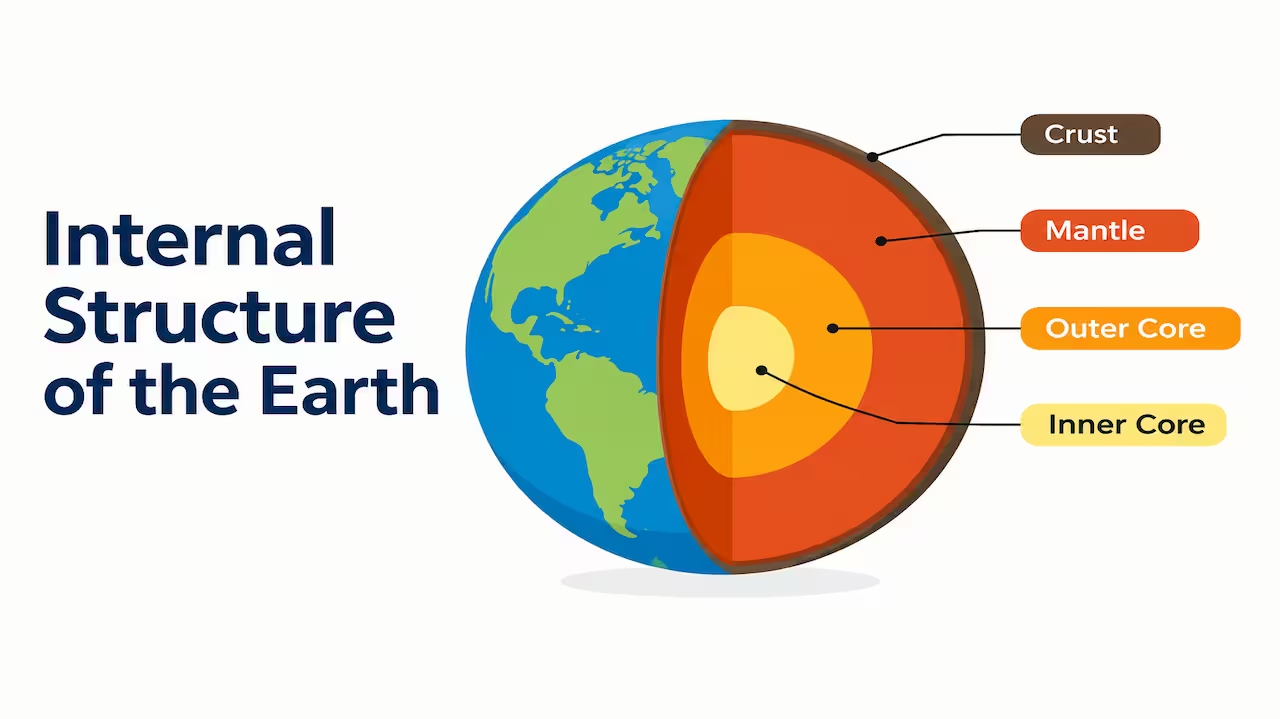
From surface to centre:
Crust — thin skin.
Mantle — the thick middle, mostly solid rock that can creep.
Outer core — liquid metal.
Inner core — solid metal.
Earth’s average radius is about 6,371 km. Almost all of that radius is mantle plus core. The crust is a coat of paint.
Average density of the planet is about 5.5 g/cm³. Surface rocks are around 2.7. So something heavy must sit in the middle. That heavy thing is the core.
I remember it as: light lid, heavy heart.
The crust: the only layer we walk on
Thickness is not one number.
Oceanic crust is thin, about 5–10 km. It is denser. Basalt and gabbro. Young, because it is born at ridges and dies in trenches.
Continental crust is thick, about 30–70 km. Under high mountains it can go deeper. It is lighter. Granite-like rock on top, more mixed below. Old pieces survive for billions of years.
Composition tags from older books still appear in papers:
- SIAL — silica + aluminium. Continental upper crust.
- SIMA — silica + magnesium. Oceanic crust and the lower crust idea.
Do not fight the examiner over whether SIMA is “exactly” the mantle. In many Indian answers, SIAL is continent, SIMA is ocean floor / lower crust. Keep it tidy.
Density: continents ~2.7, ocean crust ~3.0. That is why continents float high and ocean basins sit low. Isostasy lives in this sentence.
The crust is brittle. Earthquakes we feel are mostly here and in the top mantle. Mines and drills stop in the crust. The deepest boreholes still look like pinpricks.
Memory:
Continents are thick and light like a winter quilt. Oceans are thin and heavy like a wet towel.
Moho: the first door
The Mohorovičić discontinuity — say Moho — is the base of the crust.
P-waves suddenly speed up here. Rock type changes from crustal to ultramafic mantle rock (peridotite family).
Under oceans the Moho is shallow. Under continents it is deeper. Under the Himalaya it is pushed down. That “root” of mountains is a favourite five-mark point.
Memory:
Moho = more hurry for P-waves. Crust ends, mantle begins.
Mo-ho: mountain hole under high ranges.
The mantle: the giant
From Moho down to about 2,900 km. This is the bulk of the Earth by volume.
Upper mantle starts with hard rock. Then, not far below, comes a weaker zone.
Lithosphere = crust + the hard top of the mantle. This is the plate you draw in plate tectonics. About 100 km on average, thicker under old continents, thinner under ridges.
Asthenosphere = the softer layer below, roughly 100–400 km in many school diagrams. Not a melted ocean. Only a little partial melt and heat, enough for rock to flow over geologic time. Plates slide on this grease.
That is why “solid Earth” and “moving plates” can both be true. The plate is rigid. The seat is plastic.
The rest of the mantle is solid but can convect. Hot rock rises, cool rock sinks, over millions of years. That slow boil drives plates, volcanoes and the opening of oceans.
Lower mantle is hotter and denser. Minerals change dress under pressure. You need not name every phase for GS. You need “solid, convecting, silicate rock, rich in magnesium and iron.”
Volcanoes do not bring the whole mantle to your foot. Basalt is a melt from the upper mantle. Diamonds ride up in rare pipes from deeper levels. Still not the core.
Memory:
Lithosphere = lid. Asthenosphere = slippery seat. Lower mantle = thick engine.
Mantle is “man-tall” — the tallest layer.
Gutenberg discontinuity: the metal door
At about 2,900 km the mantle stops and the core begins.
P-waves slow down sharply. S-waves disappear. Density jumps. Chemistry jumps from silicate rock to metal.
This boundary is the Gutenberg discontinuity (core-mantle boundary). Some texts also talk of a messy layer just above it, the D″ layer. For most papers, Gutenberg is enough.
Memory:
Gutenberg = gone S-waves. Gut = deep belly of metal.
2,900 — think “29, core time.”
Why S-waves vanish: outer core is liquid. Shake-waves need a solid to shear.
The outer core: the spinning dynamo
From about 2,900 km to 5,100 km. Liquid iron-nickel, with some lighter elements (oxygen, sulphur, silicon — the exact recipe is still argued).
This liquid metal moves. The Earth spins. That motion plus convection makes the magnetic field. No liquid outer core, no compass as we know it.
Temperature is thousands of degrees. Yet we call it liquid because iron at that pressure and mix is molten. Pressure is huge, but not yet enough to freeze this layer.
P-waves pass but slower. S-waves do not.
Memory:
Outer core = oven of iron soup. Soup makes magnetism.
Lehmann discontinuity and the inner core
In 1936, Inge Lehmann read seismic records and said: there is a solid ball inside the liquid.
Around 5,100 km to 6,371 km sits the inner core. Iron-nickel again, but solid, because pressure wins.
The boundary is the Lehmann discontinuity.
The inner core grows slowly as the planet cools and iron freezes onto it. That growth helps stir the outer core. Exam papers rarely want that extra physics. They want: inner core solid, outer core liquid, both iron-nickel.
Memory:
Lehmann found the lemon seed — a hard pip inside the juice.
Inner = in-solid. Outer = out-liquid.
Radius of inner core is about 1,200-plus km. It sounds big until you remember the full radius is 6,371.
One table to pin on the wall
| Layer | Depth (approx.) | State | Main composition | Exam tag |
|---|---|---|---|---|
| Continental crust | 0–30/70 km | Solid, brittle | SIAL, granite family | Thick, light |
| Oceanic crust | 0–5/10 km | Solid | SIMA, basalt | Thin, heavier |
| Upper mantle + asthenosphere | to ~400 km+ | Solid / plastic | Peridotite, Mg-Fe silicates | Plates ride here |
| Lower mantle | to 2,900 km | Solid, convecting | Silicates under high pressure | Biggest volume |
| Outer core | 2,900–5,100 km | Liquid | Iron-nickel | Magnetic field |
| Inner core | 5,100–6,371 km | Solid | Iron-nickel | Lehmann |
Discontinuities to list in order from top:
- Conrad (sometimes; between upper and lower crust — skip if unsure)
- Moho — crust / mantle
- Gutenberg — mantle / outer core
- Lehmann — outer / inner core
Memory for the three big doors:
Mo-Gu-Le — Moho, Gutenberg, Lehmann.
Or: My Great Lunch — Moho, Gutenberg, Lehmann.
Composition tricks that actually stick
I do not memorise atomic tables. I memorise kitchens.
Crust kitchen: granite bread on continents, basalt biscuit under seas. Silica everywhere. Aluminium more in continents. Magnesium more in the ocean crust story.
Mantle kitchen: dark, dense, magnesium-iron silicates. Green-black peridotite in the mind’s eye. Not granite.
Core kitchen: metal. Iron first, nickel second. Like a meteorite cut open.
Whole-Earth rhyme I still use:
SIAL on top,
SIMA in the sea,
Soft mantle under me,
NIFE in the heart —
liquid then a stone tart.
NIFE = nickel + ferrum (iron). Old label for the core. Still printed in many guides.
Density ladder, easy numbers:
- Crust ~2.7–3.0
- Mantle ~3.3–5.5 rising with depth
- Core ~10–13
- Whole Earth ~5.5
If the average is 5.5 and the lid is 2.7, the heart must be double-digit. That one comparison answers “why do we think the core is metal?”
Seismic shadow: the proof in one diagram
P-waves leave an earthquake and bend through the core. On the far side there is a ring where direct P-waves are missing or delayed — the P-wave shadow zone, often quoted around 103° to 142° from the epicentre.
S-waves have a wider dead zone because they cannot cross the liquid outer core at all — the S-wave shadow zone beyond about 103°.
I never write the degrees unless I am sure. I do write: P-shadow proves bending at the core; S-shadow proves the outer core is liquid.
That sentence is worth more than a wrong number.
Heat, pressure, and why the inner core is solid
Pressure rises toward the centre. Temperature also rises, but not in a simple kitchen-oven way. Heat comes from leftover birth heat, friction of old formation, and radioactive decay in rocks.
So why is the hotter inner core solid and the cooler-than-centre outer core liquid? Because melting point of iron shoots up with pressure. At the inner core, the melting point sits above the actual temperature. Metal freezes. In the outer core, temperature still wins. Metal flows.
Memory:
Pressure is a stricter teacher than heat in the very centre.
How this joins other chapters
Plate tectonics: lithosphere plates, asthenosphere grease, mantle convection.
Volcanoes: melt from upper mantle or from subducted crust; not from the core.
Earthquakes: brittle crust and upper lid; deep quakes in subducting slabs.
Magnetism: liquid outer core.

Isostasy and mountains: thick light crust, Moho root.
Meteorites: pieces of core-like and mantle-like rock from dead worlds.
If you treat the interior as an orphan chapter, you lose these links. If you treat it as the basement of all physical geography, the rest of the house stands.
A walk from your shoes to the centre
Start on a Delhi roof. You are on continental crust, maybe 40 km of it under the plains, more under the High Himalaya far north.
Cross the Moho. The rock gets denser, olivine-rich.
A hundred kilometres down the lid ends. The seat is softer. Plates are dragging above you.
Keep going. The mantle is dark and slow, like cold honey if honey could be stone.
At 2,900 km the stone kitchen ends. Iron soup. No S-waves. Compass is born here.
At 5,100 km the soup freezes into a ball. You are in the inner core. Still iron. Now solid. Then 1,200 km more to the point that is only a point.
Turn around. The same doors wait in reverse: Lehmann, Gutenberg, Moho, sunlight.
That walk is the whole chapter.
How I revise the night before
I draw three circles.
I write only eight words:
Crust thin.
Mantle thick.
Outer liquid.
Inner solid.
Then the three doors: Moho, Gutenberg, Lehmann.
Then three chemistries: SIAL/SIMA, silicates, NIFE.
Then one reason: S-waves die in the outer core.
If there is time, I add lithosphere and asthenosphere for the tectonics paper.
I do not add every kilometre if my hand is shaking. Wrong depth is worse than no depth. Approximate bands are accepted when the idea is clean.
Common traps
Writing that the whole mantle is liquid. It is not. Only parts are slightly melted. The outer core is the liquid shell.
Writing that magma in a volcano comes from the core. It does not.
Forgetting oceanic crust is basalt, not granite.
Mixing Moho with Gutenberg. Moho is shallow. Gutenberg is the 2,900 km metal door.
Saying S-waves travel through the whole Earth. They do not.
Calling the inner core liquid because it is hotter. Pressure has the last word.
How to write it in the hall
2 marks: The Earth has crust, mantle and core, separated by discontinuities; the outer core is liquid iron-nickel, the inner core is solid.
5 marks: Draw a labelled section. Mention Moho and Gutenberg. SIAL/SIMA/NIFE. S-waves and liquid outer core.
10–15 marks: Begin with seismic method. Layer by layer with state and composition. Lithosphere-asthenosphere. Magnetic field. Shadow zones. Close with why surface rocks cannot explain Earth’s average density.
Draw. A neat half-Earth with four labels beats a page of adjectives.
Conclusion
The internal structure of the Earth is a rumour that became a model because waves told the truth. Thin crust we stand on. Thick mantle that creeps. Liquid metal that makes the compass. Solid metal seed in the middle.
I no longer think of an egg. I think of a lid, a slow engine, a soup, and a stone. SIAL on the continents, SIMA in the sea floor story, NIFE in the heart. Moho, Gutenberg, Lehmann as the three knocks on the way down.
You will never visit these rooms. You can still know the floor plan. That is enough for the paper, and enough to look at a mountain or a magnet and know the basement is not empty.
FAQs
Q1. What are the main layers in the internal structure of the Earth?
A: Crust, mantle, outer core and inner core. The crust and hard upper mantle together make the lithosphere. A weaker asthenosphere lies below the plates.
Q2. How do we know the outer core is liquid?
A: S-waves do not pass through it. P-waves do, but they slow and bend. That pair of facts is the classic proof.
Q3. What is the difference between SIAL, SIMA and NIFE?
A: SIAL points to silica-aluminium continental crust. SIMA to silica-magnesium oceanic / lower crustal idea. NIFE to the nickel-iron core.
Q4. Name the main discontinuities.
A: Moho between crust and mantle. Gutenberg between mantle and outer core. Lehmann between outer core and inner core.
Q5. Why is the inner core solid if it is hotter than the outer core?
A: Pressure at the centre raises the melting point of iron above the actual temperature, so the inner core stays solid while the outer core stays liquid.