Introduction
A few days ago the news was full of Anak Krakatau. Ash went up, flights stopped, and people again said “the volcano has woken.” What they were watching was not lava leaking from a long crack across a plateau. It was fire from one throat. That is a central eruption.
I used to mix the two words. Fissure. Central. Both throw lava, so both felt the same. They are not. One is a torn pipe in the ground. The other is a tap. Once that picture sits in the head, half the volcano chapter becomes easy.
If fissure eruption built the Deccan Traps, central eruption built the cones we draw in school — Fuji’s triangle, Vesuvius above the bay, Merapi above Yogyakarta, the small angry island in the Sunda Strait.
What a central eruption is
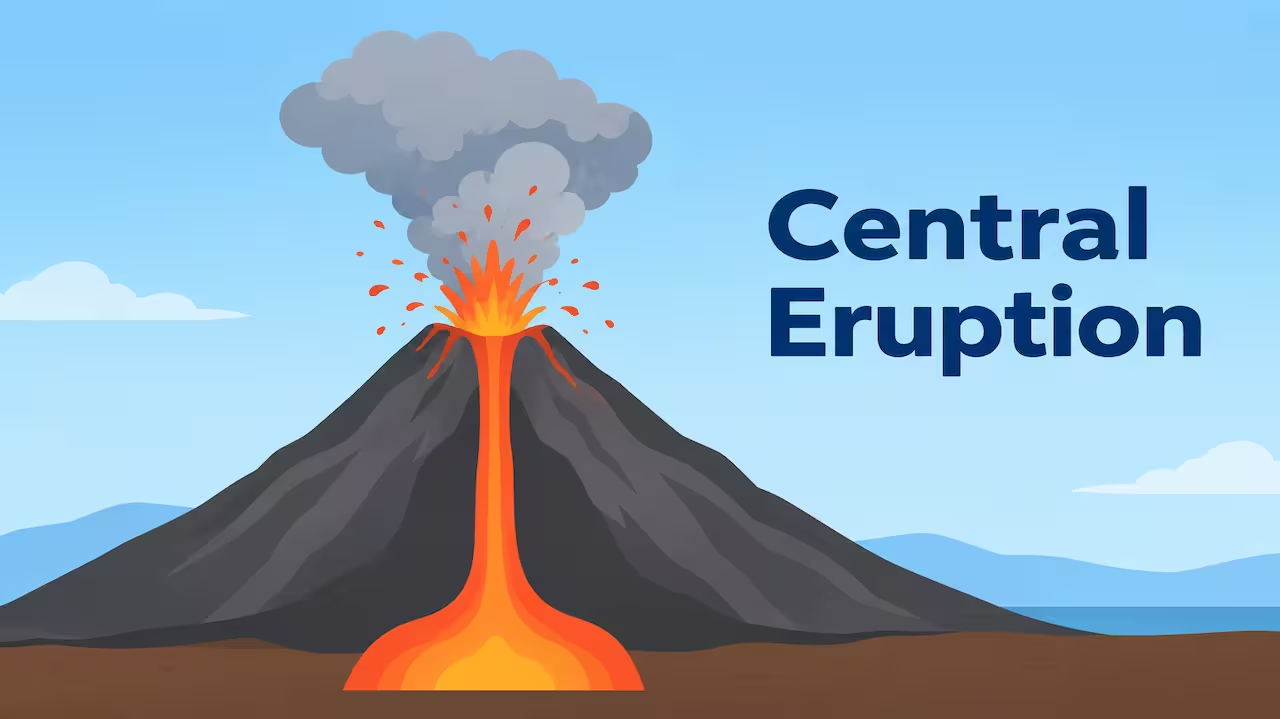
Magma rises through a pipe-like passage called a conduit. That pipe opens at the surface as a crater. Almost everything — lava, ash, gas, bombs — comes out from that centre, or from a vent very close to it.
The mountain then grows around that mouth. Layer on layer. Some days lava. Some days ash. After many years you see a cone.
A fissure eruption uses a long crack. A central eruption uses one main door. That is the whole definition, said without dressing.
The door can be quiet or violent. Hawaiian lava can still come from a central crater. Vesuvius can still use a central crater and blow a column to the sky. Same geometry. Different mood.
Why this is in the syllabus, and why news keeps proving it
Books split eruptions by the shape of the opening:
- Central type — pipe and crater
- Fissure type — linear crack
Anak Krakatau in September 2026 was central type. Stromboli is central type almost every week. When Mount St. Helens blew its side in 1980, the magma still belonged to a central system, even though the blast tore the flank.
Exams like this split because landforms change with it. Central vent → cone, crater, sometimes caldera. Fissure → lava plateau, flood basalt, crater row.
If a question says “account for volcanic landforms,” start with this fork. Then give one Indian and one world example for each side.
How the pipe works
Under the volcano sits a magma chamber. Pressure and buoyancy push melt upward. The easiest path is often an old conduit. Gas expands as the melt rises. If the melt is runny and poor in gas, it overflows. If it is sticky and rich in gas, the plug bursts.
Around the crater you may find:
- a funnel-shaped crater
- a rim of welded spatter
- a lava dome if the melt is too thick to flow far
- parasitic cones on the sides, still fed from the same system
Parasitic cones confuse students. They look like extra volcanoes. They are side doors of the same house.
Central eruption is not one style
This is where people lose marks. “Central” tells you where it comes out. It does not tell you how wildly.
Hawaiian style from a centre
Runny basalt lakes and fountains in a summit crater. Mauna Loa and Kilauea can do this at the top and send magma into rift fissures. So Hawaii sits in both chapters. Write that. It shows you read past the heading.
Strombolian
Short, noisy bursts from a central crater. Bombs fall back on the cone. Anak Krakatau lives here most years. Stromboli gave the name.
Vulcanian
Sharper blasts. A plug of cooled rock breaks. Ash shoots up, then falls. Many composite cones do this between bigger events.
Plinian
A tall, sustained column. Ash travels far. Pyroclastic flows may race down the slopes. Vesuvius 79 CE. Krakatau 1883. Pinatubo 1991. These are still central in origin. The pipe is there. The explosion is just enormous.
Pelean
A dome grows, then collapses. Glowing clouds sweep the flank. Mount Pelée, 1902, Martinique.
So: central vent + quiet flow = shield growth.
Central vent + mixed lava and ash = composite cone.
Central vent + one giant emptying = caldera.
Same family. Different years.
Landforms born from a central vent
Volcanic cone
The basic pile. Cinder cones are small and steep, made of loose bits. Composite cones are taller, layered, dangerous.
Crater
The bowl at the top. When the volcano sleeps, a lake may sit in it.
Caldera
If the chamber empties fast, the roof falls in. The crater becomes a wide basin. Krakatau 1883. Crater Lake in Oregon. Sometimes a new cone grows inside — Anak Krakatau is that child.
Lava dome
Sticky lava that cannot run. Looks like a mound in the crater.
Pyroclastic deposits
Ash, pumice, welded tuff on the slopes and in the valleys. These, not the pretty lava streams, kill most people around composite cones.
Lahar channels
Rain or melted ice mixes with ash. A mudflow follows the river. Merapi and many Andes peaks are famous for this.
I mark one line in notes: central eruption builds height; fissure eruption builds width.
Types of volcano by shape (almost all of these use a centre)
Shield
Central (and rift) feeding of runny lava. Low slope. Mauna Loa.
Composite / stratovolcano
The exam favourite. Central pipe. Layers. Fuji, Vesuvius, Merapi, Cotopaxi, Rainier, Anak Krakatau, Barren Island.
Cinder cone
Parícutin, Mexico. One vent. Short life. Steep.
Caldera system
A central system that grew too big and collapsed. Then it may start again from the middle.
Active, dormant, extinct still apply. Anak Krakatau is active. Many old cones on worn plateaus are extinct. Kilimanjaro is the usual “dormant” example in school lists. The activity label is about time. The central label is about the opening.
Examples I keep on one page
Anak Krakatau, Indonesia
Active central cone inside the 1883 caldera. September 2026: long ash episode, then Strombolian bursts. Best “in news → static” bridge this month.
Krakatau, 1883
Same system, far bigger. Central, then caldera and tsunami. More than 36,000 dead, mostly from waves.
Vesuvius, Italy
Plinian textbook. Buried Pompeii. Still a central composite above a crowded bay.
Mount Fuji, Japan
The cone everyone can draw. Composite. Sacred, photographed, still classed with active systems.
Mount Merapi, Indonesia
Often in Indian newspapers because it erupts often. Domes, pyroclastic flows, lahars.
Mount St. Helens, USA, 1980
Lateral blast from a central stratovolcano. Good reminder that “central” does not mean “only upward.”
Barren Island, Andaman Sea
India’s active volcano. Central cone on the same broad island-arc idea as Indonesia. Use it when the paper wants an Indian example that is not Deccan.
Mount Etna, Sicily
Central summit plus many side vents. Another “both doors” volcano, like Hawaii.
Deccan Traps
Do not put this under central eruption. That is fissure and flood basalt. The contrast is the point.
Central eruption versus fissure eruption
| Point | Central eruption | Fissure eruption |
|---|---|---|
| Opening | Pipe and crater | Long crack |
| Common picture | Cone | Plateau or lava field |
| Magma | From basalt to sticky andesite/rhyolite | Mostly runny basalt |
| Style | Quiet to Plinian | Mostly quiet floods and fountains |
| Exam examples | Vesuvius, Fuji, Anak Krakatau, Barren Island | Deccan Traps, Laki, Columbia River |
| Main risk | Ash, pyroclastic flow, lahar, blast | Lava sheets, gas, climate haze |
A shield volcano can cheat the table. It is built from a centre and from fissures on its arms. If the question is strict, say so in one sentence.
Where central volcanoes stand on the map
Most tall composite cones sit on convergent margins. Ocean plate goes down. Melt rises. A chain of central volcanoes is born — Andes, Cascades, Japan, Indonesia, the Philippines.
Hotspot shields — Hawaii — use a central vent over a plume.
Mid-ocean ridges are mostly fissure. That is why Iceland looks different from Java even though both are famous for fire.
India’s exam map then becomes clean:
- Peninsula flood basalt → old fissure world
- Andaman’s Barren Island → living central cone on an arc
- No need to force Deccan into the Krakatau box
Hazards that belong to this family
Ash column — aircraft, roofs, lungs. That was the 2026 headline around Anak Krakatau.
Pyroclastic flow — the fast, hot cloud. Vesuvius, Pelée, Merapi.
Lahar — the wet concrete in a river bed.
Ballistic bombs — near the crater.
Flank collapse and tsunami — if the cone stands in the sea, as in 2018 at Anak Krakatau.
Climate cooling — only when a Plinian or larger event pumps sulphur high enough. 1883 did. A weekly Strombolian pop does not.
Write the hazard that matches the event. Do not paste “tsunami” on every central eruption. Vesuvius does not make a Sunda Strait wave.
How I remember it the night before the paper
One tap, one mountain.
One crack, one plateau.
Then four names:
- Central composite: Vesuvius
- Central in the news: Anak Krakatau
- Central in India: Barren Island
- Not central: Deccan
And one extra line: style can change, the pipe can stay.
If I have thirty seconds more, I add: Hawaiian and Strombolian can both be central; Plinian is central at its most violent.
How to write this in the hall
2 marks: Central eruption is the outburst of lava and pyroclastics through a single main vent or pipe, usually building a cone. Example: Vesuvius / Anak Krakatau.
5 marks: Define. Contrast with fissure. Give landforms (cone, crater, caldera). One quiet example, one violent example.
10–15 marks: Start with Anak Krakatau 2026 or any current cone in the news. Explain the conduit. Classify styles. Place composite volcanoes on subduction zones. Contrast Deccan. Close with hazards.
Keep sentences short. Do not spend a page on magma chemistry unless asked.
Conclusion
A central eruption is the Earth using one throat. Sometimes that throat only leaks. Sometimes it screams. The mountain we recognise — the triangle on a postage stamp — is almost always this type.
This month’s ash over the Sunda Strait was a reminder, not a new chapter. Anak Krakatau is a living central cone inside an old caldera. Vesuvius is the history-book cousin. Barren Island is the Indian cousin. Deccan is the other family.
If you can say that in eight lines, you have the topic. The rest is examples and a neat table. The pipe will erupt again somewhere. The definition will not change.
FAQs
Q1. What is a central eruption?
A: It is an eruption from a main pipe and crater, not from a long surface crack. Lava and ash come out around one centre and often build a cone.
Q2. How is it different from a fissure eruption?
A: Fissure eruption uses a linear crack and spreads lava into sheets or plateaus, like the Deccan Traps. Central eruption uses one vent and usually builds height — a shield or a composite mountain.
Q3. Is Anak Krakatau a central eruption volcano?
A: Yes. It is an active composite cone feeding from a central crater inside the 1883 Krakatau caldera. The September 2026 ash bursts came from that system.
Q4. Are all central eruptions explosive?
A: No. A central crater can feed quiet basaltic lava, as at Hawaiian summits. Explosive Plinian columns also use a central conduit. The opening is the same idea; the magma and gas decide the violence.
Q5. Give two exam examples of each type.
A: Central: Vesuvius and Anak Krakatau (also Barren Island for India). Fissure: Deccan Traps and Laki in Iceland.