Introduction
When I first read “fissure eruption” in a geography book, I pictured one tall mountain blowing its top. That picture is wrong. A fissure eruption is not a cone shouting at the sky. It is lava coming out of a long crack in the ground, often quietly, and spreading like a flood.
That one idea is enough to unlock a whole set of questions in UPSC, SSC, State PSC, NDA and school boards: types of volcanoes, Deccan Traps, Iceland, flood basalt, lava plateau, and why some eruptions kill by gas and famine rather than by a single blast.
What a fissure eruption is
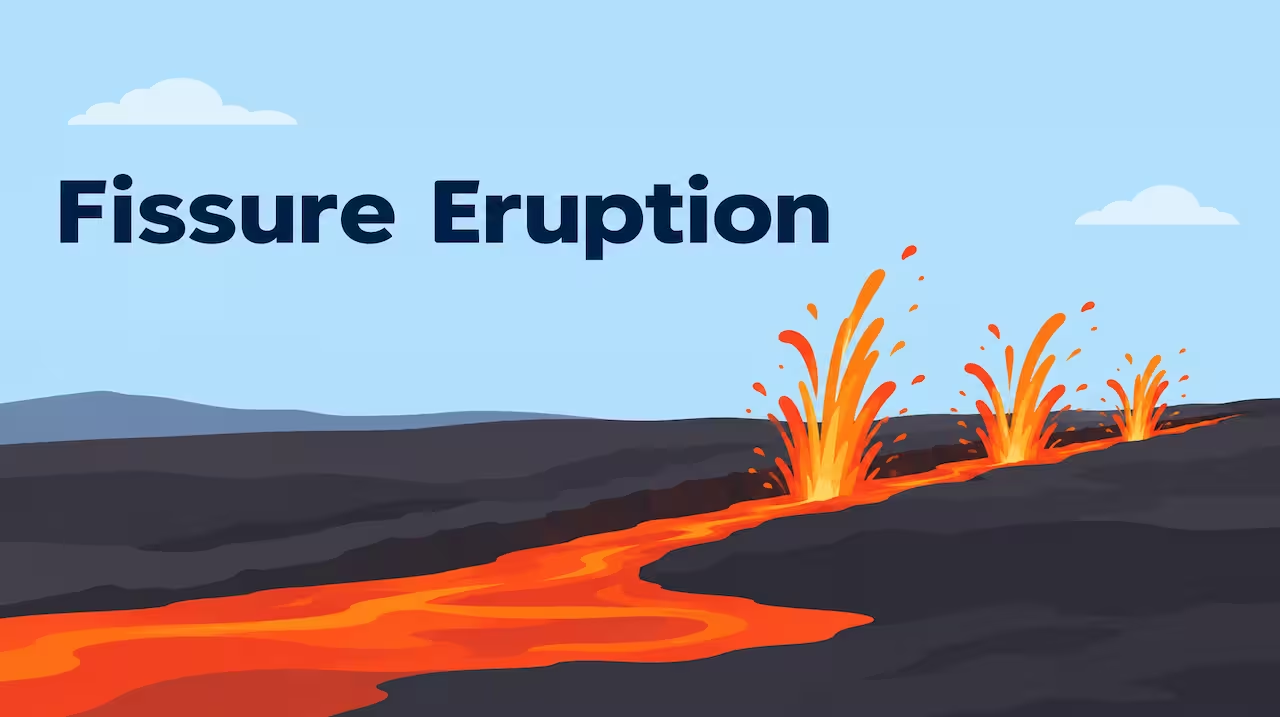
The Earth’s crust is not a smooth plate. It breaks. A fissure is a long, narrow crack. When magma from below finds that crack and reaches the surface, lava pours out along a line instead of from one round mouth.
Think of a central-vent volcano as a tap. Think of a fissure as a torn pipe. Water from a tap makes a fountain. Water from a torn pipe spreads across the floor. Fissure lava does the same. The opening may be only a few metres wide, but it can run for kilometres.
Most of this lava is basalt. Basalt is hot, thin and runny. Gas escapes easily, so there is usually little explosion. What you see is a wall of fountains along the crack — people call it a “curtain of fire” — and then sheets of lava moving across the land.
After some days or weeks, the whole crack may stop working equally. Activity often gathers at a few spots. Those spots build small spatter cones or a row of craters. The row itself is a clue: if cones sit in a straight line, the feeder was a fissure.
Why the lava behaves this way
Three things decide the mood of an eruption: how sticky the magma is, how much gas it holds, and how it opens to the air.
Basaltic magma is poor in silica, so it is not sticky. Temperature is high, often around 1000–1200°C. Gas can leave without building a bomb inside the mountain. That is why fissure eruptions are mostly effusive. They flow. They do not usually throw a huge ash column like Vesuvius or Mount St. Helens.
This is also why books group them with the “quiet” or Icelandic style. Quiet does not mean safe. A quiet flood can bury farms, fill valleys, poison air and change climate.
Fissure eruption versus central eruption
This comparison is a favourite in exams.
A central eruption uses one main pipe. Magma rises through a conduit and comes out at a crater. Repeated bursts build a cone. If lava and ash take turns, you get a composite volcano. If only runny lava piles up around one centre, you get a shield volcano.
A fissure eruption uses a crack. There is no need for a tall cone. Lava spreads sideways. Many flows, one on top of another, make a plateau. The land looks stepped after rivers cut through the layers. That stepped look is why old writers used the word “traps” for places like the Deccan.
Remember this line for MCQs:
Central vent → cone.
Fissure vent → lava sheet / plateau.
Shield volcanoes sit in the middle of this story. Hawaii’s big shields grow from a summit and from rift zones on their sides. Those rift zones are fissures. So a shield can have both a centre and long cracks.
Where fissures open
You will meet three settings again and again.
1. Divergent plates and rifts
When two plates pull apart, the crust thins and cracks. Mid-ocean ridges erupt this way under the sea and make pillow lava. On land, Iceland sits on the Mid-Atlantic Ridge, so fissures are common. The East African Rift is the same idea on a continent.
2. Hotspots and plume heads
A hot column from the deep mantle can melt huge volumes of rock. When that melt reaches a continent, it may not build one pretty cone. It may open many cracks and drown a region in basalt. This is how large igneous provinces form.
3. Flanks of shield volcanoes
Kilauea and Mauna Loa in Hawaii send magma into rift zones. The 2018 lower east rift of Kilauea was a modern classroom: fountains along a crack, new land, homes lost to lava, not to a single summit blast.
What landforms grow from fissures
If you only remember products, remember these.
Lava plateau / flood basalt
Thin flows cover hundreds of kilometres. Layer after layer makes a thick pile. Surface looks flat from far away, stepped when eroded.
Lava plains and fields
Smaller cousins of plateaus. Still wide, still basaltic.
Spatter ramparts and crater rows
Bits of lava fall beside the crack and weld into low walls. Cones in a line mark the old fissure. Laki in Iceland is the classic crater row.
Lava channels and tubes
Early lava runs in open channels. The top can freeze and leave a tube. Later flows travel far inside that tube without losing heat.
Dykes
Underground, the same crack is a sheet of magma standing almost vertical. When it cools inside the crust it becomes a dyke. In western Maharashtra, many dykes are the old feeders of Deccan flows. A dyke across a river can even look like a wall.
Do not mix plateau with shield. A shield is a broad mountain built around a centre. A plateau is a wide table built from many cracks over a region.
Examples you should keep for exams
These names appear in papers more than any definition.
Deccan Traps, India
This is the example Indian exams love, and for good reason. Around 66 million years ago, near the end of the Cretaceous, repeated fissure eruptions covered a huge part of western and central India with basalt. What we see today is still about 5 lakh square kilometres. The original cover was larger; erosion has eaten a lot. In the Western Ghats the pile can be more than 2 km thick.
The landscape looks like stairs because each flow is a hard sheet and rivers have cut steps. “Trap” comes from that stair-like look.
Why it matters beyond geography: the main pulse is close in time to the end-Cretaceous mass extinction. A giant asteroid hit Earth at about the same time. Many scientists now discuss both. For a two-mark answer, write: Deccan Traps formed by fissure eruptions of basalt; linked in time with the K-Pg boundary.
Maharashtra, Gujarat, Madhya Pradesh, Karnataka and parts of Telangana sit on this old flood. Black cotton soil in parts of the Deccan is weathered basalt. That soil question and this eruption question often live in the same chapter.
Laki, Iceland, 1783–84
If the question asks for a historical fissure eruption, write Laki. A crack about 25 km long opened in 1783. Roughly 12–14 cubic kilometres of lava came out — the largest lava flow in recorded human history. It filled valleys and covered more than 500 square kilometres.
The worse killer was not the lava underfoot. The eruption released a vast amount of sulphur dioxide and other gases. A dry fog hung over Europe. Crops failed. Livestock died. Famine followed in Iceland. Climate cooled for a time. This is the example that shows a “quiet” eruption can still change weather and history.
Laki belongs to the Grímsvötn volcanic system. Another huge old Icelandic fissure is Eldgjá (tenth century), even larger in lava volume.
Hawaii: Kilauea and Mauna Loa
Hawaii is the living model. Fluid basalt, rift zones, curtains of fire, pahoehoe and aa flows. The 2018 Kilauea lower east rift eruption is recent enough that current-affairs papers have used it. Fountains rose tens of metres. Spatter cones grew. Lava reached the sea and built new land.
Use Hawaii when the question wants a present-day fissure on a shield volcano.
Columbia River Basalt, USA
Younger than Deccan, smaller than Siberian Traps, but well preserved. Flows in Washington, Oregon and Idaho. Good example of a flood-basalt province in North America. Individual flows travelled very far because the lava was so runny.
Siberian Traps
The giant. About 252 million years ago, near the end of the Permian. Volume is enormous — millions of cubic kilometres. Timing matches the worst mass extinction in Earth’s history. If a question links flood basalt and extinction, Siberian Traps is the first name, Deccan the second.
Mid-ocean ridges and East African Rift
Under the ocean, almost all new crust is born from fissures. On land, the East African Rift shows the same pulling-apart process. Nyiragongo is often in news for fast lava, but the rift as a whole is the tectonic setting you should name.
How a flood-basalt province is not “one volcano”
Exam language sometimes says “the Deccan volcano.” Be careful. A flood-basalt province is not one mountain and not one afternoon of fire. It is many fissures, many pulses, over thousands to about a million years. One flow may be huge. The province is a family of flows.
That is why the Deccan has many layers, and why dyke swarms appear in different districts. The source may be a mantle plume head. The surface result is a cracked continent leaking basalt.
Hazards: what actually goes wrong
People fear ash clouds. Fissure fields often hurt in other ways.
Lava can move slowly and still take houses, roads and farms because it does not stop for property lines. In Hawaii you can walk away from many flows. You cannot save the land.
Gases are the silent part. Sulphur dioxide makes acid rain and a haze. Fluorine can poison grass. Animals eat the grass and die. That is the Laki lesson.
If lava meets ice or groundwater, steam explosions can happen. If it meets a forest or town, fire follows. If it enters the sea, new land grows, but the steam plume is dangerous to stand in.
Climate can shift when the sulphur load is large enough. That is why Laki and the great prehistoric provinces appear in environment and history essays, not only in landform lists.
A short table for revision
| Point | Fissure eruption | Central eruption |
|---|---|---|
| Opening | Long crack | One main vent |
| Common lava | Basalt, runny | Basalt to sticky andesite/rhyolite |
| Usual style | Flow, fountains | Flow or explosion |
| Main landform | Plateau, lava field | Cone, shield, composite |
| Exam example | Deccan, Laki | Vesuvius, Fuji, St. Helens |
| Province | Region | Why remember |
|---|---|---|
| Deccan Traps | India | ~66 Ma, stairs of basalt, K-Pg time |
| Siberian Traps | Russia | End-Permian, largest scale |
| Columbia River | USA | Young, well-studied flood basalt |
| Laki 1783 | Iceland | Historic fissure, gas and famine |
| Hawaiian rifts | Hawaii | Living curtain of fire |
How I would answer in the hall
If the paper says “What is a fissure eruption? Give examples.”
Write: lava coming out along a linear crack, usually basaltic and quiet; builds plateaus not tall cones; examples Deccan Traps and Laki 1783.
If it says “Account for the origin of the Deccan Plateau.”
Write: successive fissure eruptions of basalt in the late Cretaceous; flows spread over a vast area; later erosion produced the trap landscape; possible link with a mantle plume and with the K-Pg events.
If it asks difference between shield and lava plateau:
Shield grows around a centre (Hawaii). Plateau grows from many fissures over a wide region (Deccan). Both use runny basalt. Shape and scale differ.
Keep one extra line in your head: most of the ocean floor is born from fissures. That sentence shows you understand the planet, not only one Indian plateau.
I used to think volcanoes were only mountains with smoke. Fissure eruptions taught me the ground itself can open like a seam. Once you see that, the Deccan is no longer “just black rock.” It is an old flood, frozen in layers, still holding the story of how a continent cracked and how lava, not a single peak, can change the map.
Conclusion
A fissure eruption is the Earth opening along a line, not a mountain exploding from one mouth. Runny basaltic lava comes out of a crack, spreads far, and stacks into sheets. After many such flows, the land becomes a plateau. After a short burst, you may only see a crater row or a black field.
That is why this topic keeps coming back in exams. It joins three chapters at once: types of volcanoes, landforms, and Earth’s interior. Deccan Traps tell the Indian story. Laki 1783 tells the human story. Hawaii tells the living story. Siberian Traps and Columbia River basalts tell the global story.
If you remember only four lines before walking into the hall, remember these. Fissure means crack. Lava is usually basalt. Landform is plateau, not a tall cone. Best Indian example is Deccan Traps, formed around 66 million years ago.
I no longer look at a flat lava country and think “nothing happened here.” Something huge happened. It just did not look like a postcard volcano.
FAQs
Q1. What is a fissure eruption?
A: It is an eruption from a long crack in the crust. Lava comes out along that line instead of from one central crater.
Q2. Is a fissure eruption the same as a volcano?
A: It is a type of volcanic eruption. It may not build a famous cone. The volcano here is the crack and the lava field, not a single peak.
Q3. Why is this eruption usually quiet?
A: The lava is mostly basalt. It is hot and thin, so gas escapes easily. Pressure does not build the way it does in sticky magma.
Q4. Does “quiet” mean it is harmless?
A: No. Lava can bury land. Gases can poison air, grass and animals. Laki in 1783 showed how famine and climate change can follow.
Q5. What is the difference between fissure eruption and central eruption?
A: Central eruption uses one main pipe and often builds a cone. Fissure eruption uses a linear vent and often builds a lava sheet or plateau.