A few years ago, a girl in my weekend batch told me she hated cloze tests more than any other English question. “Sir, all four options look correct,” she said. I asked her to read one blank out loud with each option. By the third option she stopped and laughed, because it sounded wrong even to her. She did not need more vocabulary. She needed a way to test the options instead of staring at them.
That is what this post gives you. These cloze test tricks are the same 5 steps I use in class, followed by 3 solved SSC-style passages and one practice passage with answers. Keep a pen in your hand and try every blank yourself before you read my explanation.
What a Cloze Test Looks Like in SSC Exams
A cloze test is a short passage with some words removed. Each gap has a number, and for each number you get four options. You pick the word that fits the sentence and also fits the passage. In SSC exams such as CGL and CHSL, it usually comes as one passage with around five blanks, so one passage can decide five questions together. The pattern can change, so always check the latest official notice for your exam.
Here is the good part. A cloze test is not a vocabulary test in disguise. Most blanks are decided by small things: an article before the gap, a preposition after it, a “however” two lines above, or the tone of the whole paragraph. Once you know where to look, you will find that two options fall away almost at once.
Students lose marks here for two reasons. First, they start filling blank 1 before they know what the passage is about. Second, they choose the word that “sounds nice” instead of the word the sentence needs. The 5 steps below fix both problems.
Cloze Test Tricks: The 5-Step Method
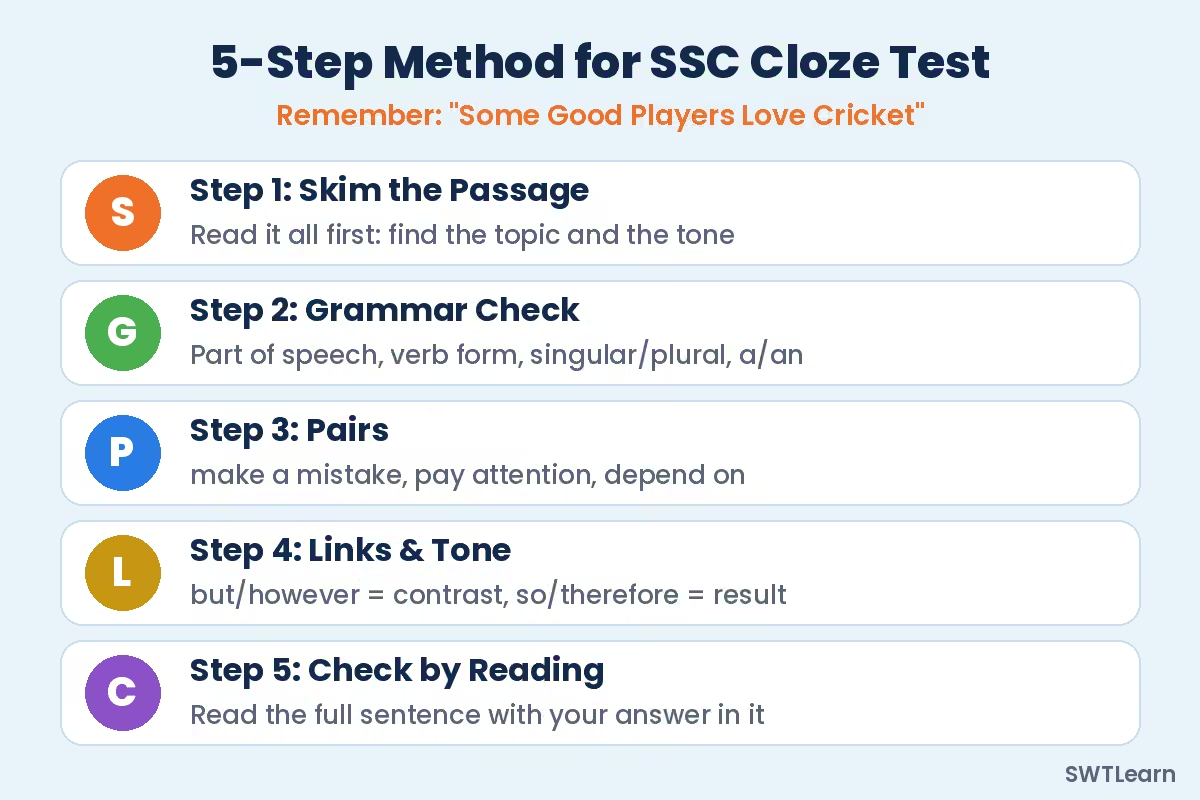
The five steps are Skim, Grammar check, Pairs, Links and tone, and Check by reading. My students remember them as “Some Good Players Love Cricket”. Silly, yes. But nobody forgets it.
Step 1: Skim the Whole Passage First
Before you touch blank 1, read the full passage quickly, blanks and all. It takes about 20 to 30 seconds. You are only looking for two things: what is the topic, and is the writer happy, worried, critical or neutral about it?
This one habit saves a lot of marks. A passage about rising pollution will not suddenly need a word like “delightful”. A passage praising a scientist will not need “careless”. When you know the direction, wrong options look wrong.
Step 2: Grammar Check Before Meaning
Look at the words right before and right after the blank. Ask four quick questions:
- Which part of speech? After “the most” or “a lot of” you need a noun. After “is very” you need an adjective. After “has” you may need a past participle.
- Which form of the verb? “Every day he ___” needs a present form. “Last year she ___” needs a past form.
- Singular or plural? “One of the boys ___” takes a singular verb, but “Both of them ___” takes a plural verb.
- Does the article match? “A ___” cannot take a word starting with a vowel sound, and “an ___” cannot take a consonant sound.
Do this check first, even if you think you know the meaning. Grammar is the fastest filter you have. It often removes two options in five seconds, and then you are choosing between only two words.
Step 3: Pairs: Words That Always Go Together
English has fixed pairs. We make a mistake but do homework. We pay attention, take part, catch a cold and keep a promise. Examiners love these because a student who translates from Hindi in the head will often choose the wrong verb.
Prepositions work the same way. We say “interested in“, “depend on“, “aware of“, “good at” and “instead of“. If the word after the blank is “of”, any option that does not go with “of” is out.
You cannot learn every pair in one night. Keep a small notebook and write down five new pairs a day from newspaper editorials. In a month you will have 150, and you will start hearing the right one.
Step 4: Links and Tone: Follow the Connectors
Connectors tell you how a sentence relates to the one before it. If you studied our para jumbles tricks, you already know this idea. The same words help here, just in a different way.
- Contrast: but, however, yet, although, on the other hand. The idea after the blank turns the other way.
- Addition: and, also, moreover, in addition. The idea continues in the same direction.
- Result: so, therefore, as a result, that is why. The second idea is caused by the first.
Sometimes the blank is the connector itself. Then read both sentences and ask, “Is the second one agreeing, disagreeing, or giving a result?” The answer tells you which group to pick from.
Step 5: Check by Reading the Full Sentence
When you have chosen a word, read the whole sentence again with your answer in it. Read it slowly, like you are reading it to a younger brother. If it sounds broken anywhere, something is wrong. This takes five seconds and catches most silly mistakes, especially in verb forms.

One more tip. The passage often gives you the answer somewhere else. If line 4 talks about “wasting water”, the blank in line 2 is probably about the same idea. I call this “the passage echo”. Look for it whenever you are stuck.
3 Solved SSC-Style Cloze Passages
I wrote these passages for practice. They are not actual previous-year questions, but the level and style are close to what you will see in SSC papers. Try all five blanks of a passage first, then read the answers.
Solved Passage 1 (Easy)
Ramesh runs a small tea stall near the bus stand of our town. Every morning he (1) ______ his stall at five o’clock, long before the first bus arrives. He is not a rich man, (2) ______ he keeps a box of old books on a shelf for anyone who wants to read. Students waiting for the bus often sit on his bench and (3) ______ through these books. Last year, a girl who used to read there (4) ______ the state civil services exam. She came back with a box of sweets and said that his little shelf had (5) ______ a big difference to her life.
1. (a) open (b) opens (c) opened (d) opening
2. (a) so (b) because (c) but (d) and
3. (a) look (b) see (c) watch (d) find
4. (a) clears (b) cleared (c) has cleared (d) will clear
5. (a) done (b) made (c) given (d) taken
Answers: 1 (b), 2 (c), 3 (a), 4 (b), 5 (b)
- Blank 1, opens: “Every morning” shows a daily habit, so we need the simple present. The subject “he” is singular, so “opens”, not “open”.
- Blank 2, but: “Not a rich man” and “keeps books for anyone” pull in opposite directions. That is a contrast, so “but”.
- Blank 3, look: “Look through” means to read quickly. “See through” means something else, and “watch” and “find” do not take “through” here. This is a pair question.
- Blank 4, cleared: “Last year” fixes a past time. “Has cleared” cannot sit with a finished time like “last year”.
- Blank 5, made: The fixed pair is “make a difference”. Many students pick “given” because it sounds generous. The pair decides it.
Notice that not one of these five blanks needed a difficult word. Grammar decided three, a connector decided one and a pair decided one. Most SSC cloze tests are like this.
Solved Passage 2 (Medium)
Many Indian cities face floods in the monsoon and a water crisis in the summer. Experts say the real problem is not a (1) ______ of rain but a lack of planning. Most of the rainwater simply flows into drains and is (2) ______. Rainwater harvesting is a simple answer to this. (3) ______ letting the water run away, we collect it from rooftops and send it into the ground. This slowly (4) ______ the level of groundwater in the area. If more homes (5) ______ this habit, our cities will depend much less on tankers in summer.
1. (a) shortage (b) absence (c) excess (d) amount
2. (a) wasted (b) saved (c) stored (d) used
3. (a) Despite (b) Instead of (c) Because of (d) In spite
4. (a) raises (b) rises (c) arises (d) arouses
5. (a) adopt (b) adapt (c) adopted (d) will adopt
Answers: 1 (a), 2 (a), 3 (b), 4 (a), 5 (a)
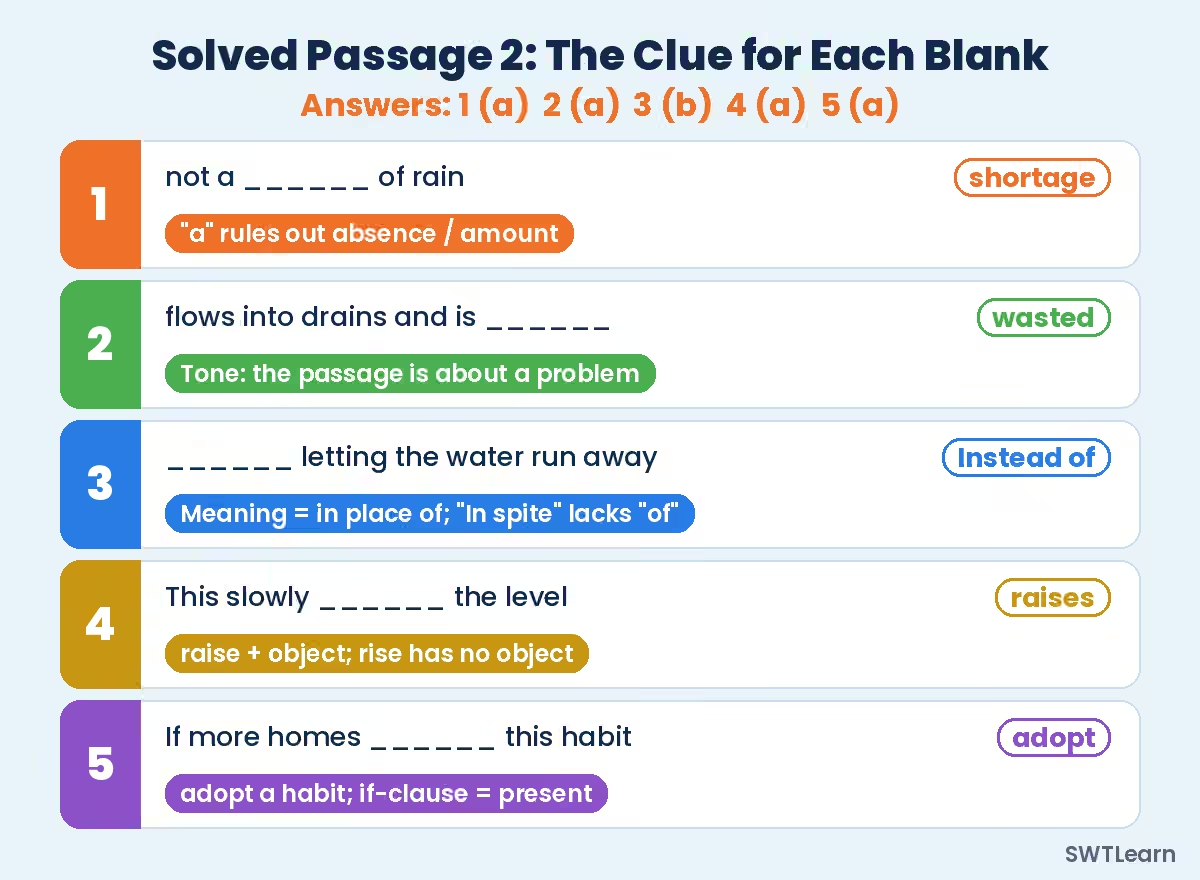
- Blank 1, shortage: The article is “a”, so “absence” and “amount” are out at once, because both start with a vowel sound and would need “an”. “Excess of rain” is the opposite of the idea. Only “shortage” is left.
- Blank 2, wasted: The tone of the passage is a problem. Water running into drains is a loss, so “wasted”. The passage echo helps too: the next lines are about saving water, which only makes sense if it was wasted before.
- Blank 3, Instead of: “In spite” is incomplete without “of”, so it is out on grammar. “Despite” and “Because of” do not make sense: we collect water in place of letting it run away. “Instead of” fits.
- Blank 4, raises: This is a favourite SSC trap. “Rise” does not take an object (prices rise). “Raise” takes an object (it raises the level). Here “the level” is the object, so “raises”.
- Blank 5, adopt: “Adopt” means to take up a habit. “Adapt” means to change to suit something. Also, in an “if” sentence about the future, the if-part takes the simple present, so not “will adopt”.
Solved Passage 3 (SSC CGL Level)
Not long ago, a student preparing for a government exam had to move to a big city to join a coaching centre. Today, a learner in a small village can (1) ______ the same classes on a phone. This change has made good teaching (2) ______ to lakhs of students who could never afford to leave home. (3) ______, the phone that brings the lecture also brings endless distractions. A short break to check one message can easily (4) ______ into an hour of scrolling. The students who do well online are usually not the ones with the best phones, but the ones with the most (5) ______.
1. (a) attend (b) attain (c) assist (d) appear
2. (a) access (b) accessible (c) accessing (d) accessed
3. (a) Moreover (b) Therefore (c) However (d) Similarly
4. (a) turn (b) become (c) make (d) take
5. (a) money (b) discipline (c) talent (d) luck
Answers: 1 (a), 2 (b), 3 (c), 4 (a), 5 (b)
- Blank 1, attend: We attend a class. “Attain” means to achieve a goal, and “assist” means to help. “Appear” would need “in” and still would not suit classes. Words that look alike are a common trick, so read each option fully.
- Blank 2, accessible: The pattern is “made something + adjective”, like “made it easy”. Only “accessible” is an adjective. This is a pure part-of-speech question.
- Blank 3, However: The sentence before is positive (good teaching reaches everyone). The sentence after is negative (endless distractions). That is a turn, so we need contrast. “Moreover” and “Similarly” continue the same direction, and “Therefore” gives a result.
- Blank 4, turn: “Turn into” means to change into something. “Become into” is wrong English, and “make” or “take” do not fit with “into an hour”.
- Blank 5, discipline: The whole passage is about distraction, and the sentence itself says it is not about the best phones. So money is ruled out by the sentence, and luck or talent has nothing to do with the problem described. The passage echo points to discipline.
This passage is closer to a CGL paper because two blanks need you to think about the full passage, not just the sentence. That is why Step 1 matters. If you skip the skim, blank 5 becomes a guess.
Common Mistakes Students Make in Cloze Tests
- Filling blanks before reading the passage. You end up changing answers later, and that wastes time. Skim first, always.
- Choosing the hardest word. Students think a difficult word must be the correct one. In SSC, the answer is very often the simple, common word.
- Ignoring the word after the blank. A preposition right after the gap (“of”, “on”, “in”) can decide the answer by itself.
- Translating from Hindi in your head. This is how people end up writing “do a mistake” or “discuss about the plan”. Trust English pairs, not translation.
- Never reading the final sentence. A five-second read with your answer in place catches most errors in tense and number.
When You Are Stuck Between Two Options
It happens to everyone. You have removed two options, and the last two both seem fine. Here is what I tell my students to do, in this order.
First, check if one of them breaks a pair. “Pay attention” is fixed, so “give attention” loses even though it sounds polite. Second, check the tone. If the passage is critical, the positive word is probably wrong. Third, look for the passage echo, a word or idea that repeats in another line. Fourth, if nothing works, pick the simpler and more common word and move on. Don’t spend more than a minute on one blank. There are four more waiting.
Practice Passage: Try This One
Solve all five blanks before you open the answers at the end.
My grandmother never went to school, (1) ______ she can do sums faster than anyone in our family. She learned to count by selling vegetables in the weekly market. Customers would (2) ______ her a note, and she would return the change before they could check it. When I asked her the secret, she laughed and said that practice is the best (3) ______. Even now, at seventy, she (4) ______ her own accounts in a small notebook. I have never seen her (5) ______ a mistake.
1. (a) and (b) so (c) yet (d) because
2. (a) hand (b) take (c) borrow (d) get
3. (a) teach (b) teacher (c) teaching (d) taught
4. (a) keep (b) keeps (c) kept (d) keeping
5. (a) do (b) make (c) take (d) give
A Simple 7-Day Plan for Cloze Tests
If your exam is close, don’t try to learn everything. Do this for one week:
- Day 1 and 2: Solve two passages a day using only Steps 1 and 2. Notice how many blanks grammar alone decides.
- Day 3 and 4: Add Step 3. Write every new pair you meet in your notebook.
- Day 5: Focus on connectors. Circle every however, so and moreover in your passages.
- Day 6: Take a timed set of four passages. Aim for about four minutes per passage.
- Day 7: Go through every mistake from the week and write why you got it wrong in one line.
That last step is the one most students skip, and it is the one that helps the most.
FAQ on SSC Cloze Test
Q1. What is the fastest way to solve a cloze test in SSC?
A: Skim the full passage first, then check grammar around each blank before thinking about meaning. Grammar usually removes two options quickly, and the tone of the passage decides the rest.
Q2. How much time should I spend on one cloze passage?
A: With practice, about three to four minutes for a five-blank passage is enough. Spend the first 20 to 30 seconds skimming, and never more than a minute on a single blank.
Q3. Do I need a big vocabulary to score well in cloze tests?
A: Not really. Most blanks are decided by grammar, fixed word pairs and connectors. A good list of common pairs like “make a difference” and “pay attention” helps more than learning rare words.
Q4. Should I solve the blanks in order?
A: Not always. Fill the easy blanks first. Each answer you fill makes the passage clearer, and that often makes the difficult blank easier.
Q5. Is the cloze test asked in SSC CHSL too?
A: Cloze tests appear in the English sections of several SSC exams, including CGL and CHSL. The number of questions can change, so always check the latest official syllabus for your exam.
Q6. How can I improve at cloze tests in a short time?
A: Solve two passages a day with the 5-step method, keep a notebook of word pairs, and read one newspaper editorial daily. Write down why each wrong answer was wrong.
Answers to the Practice Passage
Click to see the answers
1 (c) yet. “Never went to school” and “can do sums faster than anyone” are opposite ideas, so we need contrast. “Yet” is the only contrast word in the options.
2 (a) hand. Customers give her a note, and “hand someone something” means to give it. “Take her a note” and “get her a note” change the meaning, and “borrow” does not work this way.
3 (b) teacher. After “the best” we need a noun. “Practice is the best teacher” is also a common saying.
4 (b) keeps. “Even now” shows the present, and “she” is singular. To “keep accounts” is also a fixed pair.
5 (b) make. We always “make a mistake”, never “do a mistake”.
That’s the whole method. Use these cloze test tricks on two passages a day for two weeks and you will see the change in your mock scores. Many students tell me cloze tests became their safest English questions once they stopped guessing and started checking. For daily practice passages and more memory tricks, join the SWTLearn Telegram channel.