
I still remember a student in my evening batch who used to skip every para jumble in his mock tests. “Sir, it is pure guesswork,” he told me. Two weeks later he was getting four out of four right. He had not become better at English in two weeks. He had only learned where to look.
That is what this post is about. These para jumbles tricks are the same 5 steps I teach in class, followed by 10 solved SSC-style examples and a short practice set. Do the examples with a pen, not just your eyes.
What Para Jumbles Look Like in SSC CGL and CHSL
In SSC exams like CGL and CHSL, para jumbles usually come in two forms:
- Sentence rearrangement: four or five sentences of a short paragraph are mixed up and labelled P, Q, R, S (and sometimes T). You choose the option that gives the correct order.
- Parts of one sentence: the first part of a sentence is given, and the rest is broken into four jumbled parts. You join them so the sentence makes sense.
The number of such questions changes from exam to exam, so don’t depend on any fixed count. Most students lose marks here not because the question is hard, but because they read all four sentences again and again without a plan.
Para Jumbles Tricks: The 5-Step Method
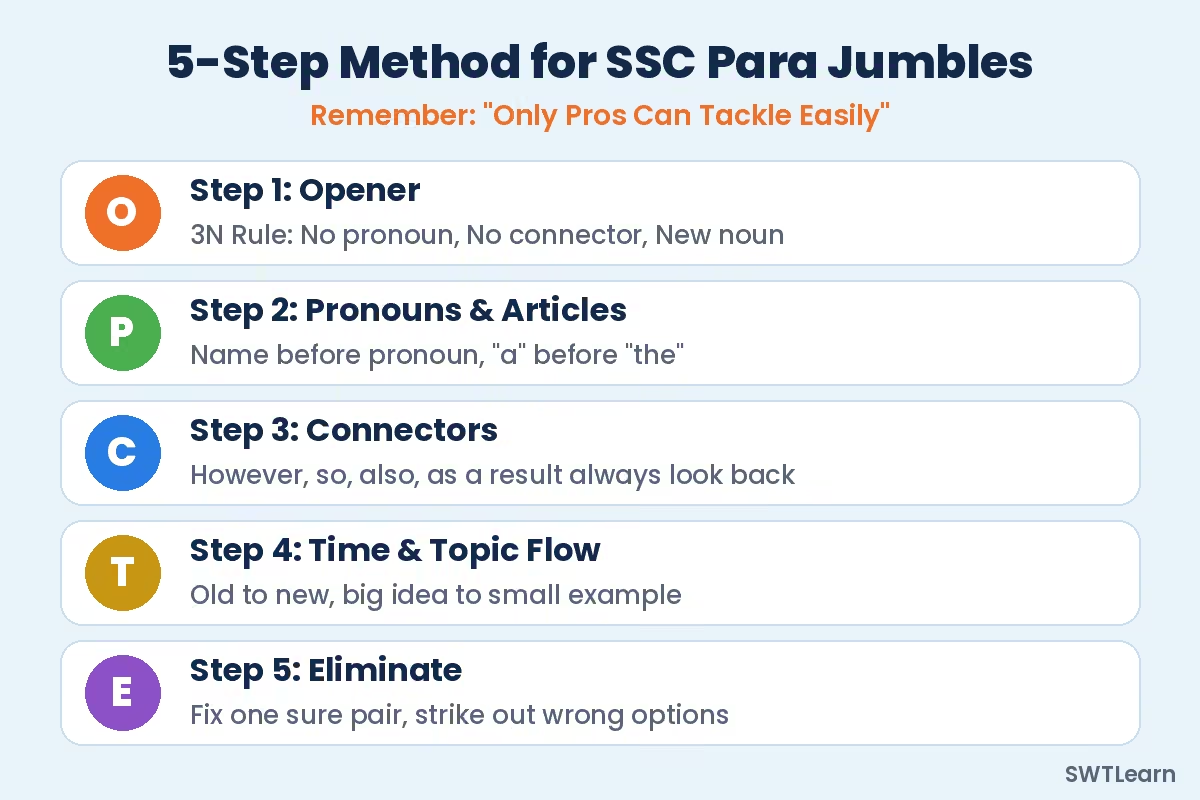
The five steps are Opener, Pronouns and articles, Connectors, Time and topic flow, and Elimination. My students remember them as “Only Pros Can Tackle Easily”.
Step 1: Find the Opener with the “3N Rule”
The first sentence must stand on its own. Check it for three things:
- No pronoun that points back: he, she, it, they, this, these, such.
- No connector at the start: however, but, so, therefore, also, as a result.
- New noun: it introduces the person or topic, often with a full name or “a/an”.
Usually only one or two sentences pass this test. Often you can cut two options in the first ten seconds.
Step 2: Pronouns and Articles – “Name Before Pronoun, A Before The”
If a sentence says “she”, the sentence that names her must come before it. Similarly, a writer says “a young engineer” the first time and “the engineer” after that.
Watch “this”, “these” and “such” too. “These qualities” means the qualities were just listed.
Step 3: Connectors Always Look Back
Words like however, but, yet, so, therefore, also, in fact, as a result, that is why join a sentence to the one before it, so they never start the paragraph.
- However / but / yet means a contrast with the previous idea.
- So / therefore / as a result / that is why means a result. These often come near the end.
- Also / in fact / moreover means one more point on the same side.
Step 4: Time and Topic Flow – “Old to New, Big to Small”
If you see years or words like “first”, “then”, “later”, “today”, put them in time order. Without time clues, check the topic flow: big idea to specific example, or problem to solution to result.
Step 5: Fix a Pair, Then Eliminate
You don’t need the full order to get the answer. Find one pair you are sure about, like “R must come right after S”, and strike out every option that breaks it. Usually the opener plus one strong pair leaves only one option standing.
After checking hundreds of answer sheets, I have noticed that students who use Step 5 finish these questions much faster than those who build the whole paragraph in their head.
10 Solved SSC-Style Para Jumbles
I wrote these SSC-style examples for practice. They are not actual previous-year questions. Try each one before reading the explanation.
Example 1
P. But once it started bearing fruit, the whole street waited for summer.
Q. Today, its mangoes are shared with every family in the lane.
R. Rohan’s grandfather planted a mango tree in their village courtyard fifty years ago.
S. It grew slowly at first and gave no fruit for many years.
(a) SRPQ (b) RPSQ (c) RSPQ (d) QRSP
Answer: (c) RSPQ
Clues: R is the only sentence that names the tree, so it opens (3N rule). “It grew slowly” in S needs the tree, so S follows R. “But once it started bearing fruit” contrasts with “no fruit” in S. “Today” ends the story.
Example 2
P. The pump cost less than a mobile phone.
Q. Soon, the engineer was getting orders from three states.
R. Farmers who used it saved a lot of money on diesel.
S. A young engineer from Pune built a small solar water pump for farmers.
(a) SRPQ (b) SPRQ (c) PSRQ (d) SPQR
Answer: (b) SPRQ
Clues: “A young engineer” and “a small solar water pump” are first mentions, so S opens. “The pump” in P comes next. Farmers must use the pump and save money before the orders start coming in, so R comes before Q.
Example 3
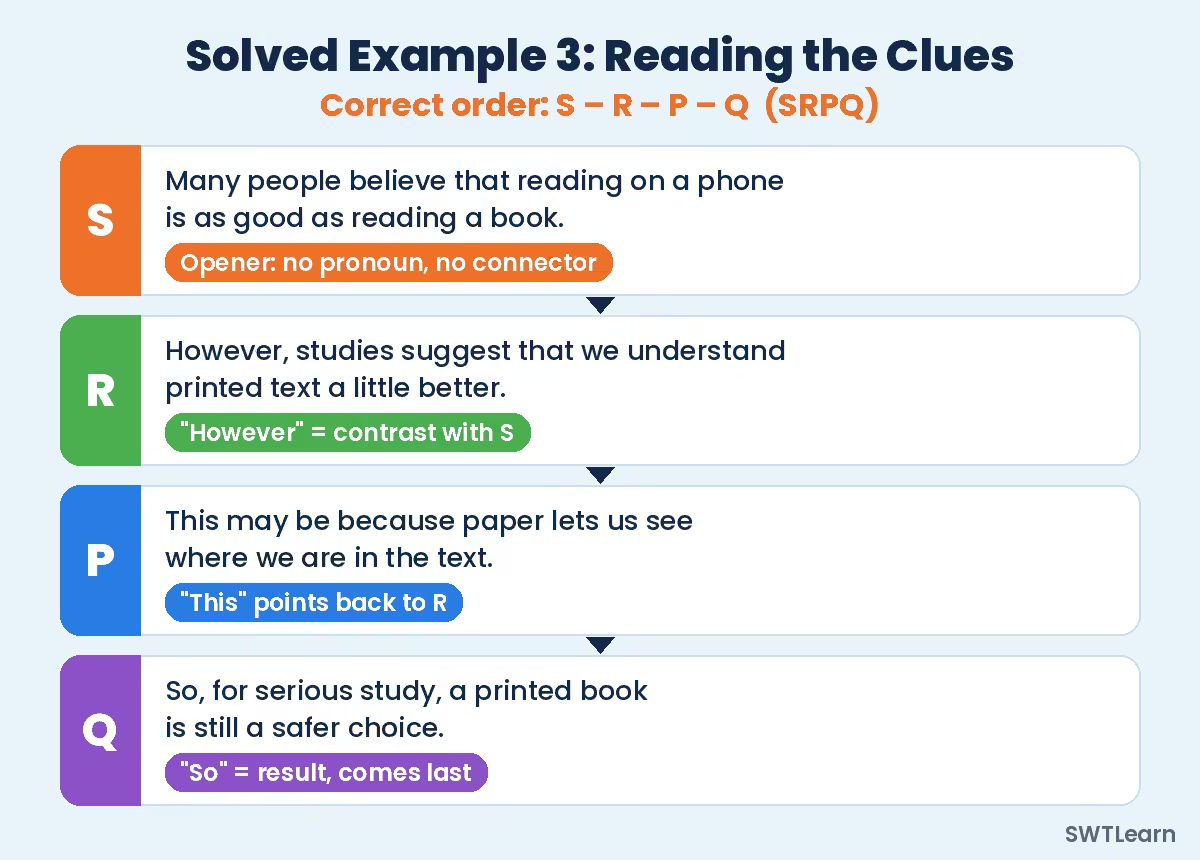
P. This may be because paper lets us see where we are in the text.
Q. So, for serious study, a printed book is still a safer choice.
R. However, studies suggest that we understand printed text a little better.
S. Many people believe that reading on a phone is as good as reading a book.

(a) SPRQ (b) RSPQ (c) SRPQ (d) SRQP
Answer: (c) SRPQ
Clues: S states a common belief and has no connector. “However” in R argues against it. “This may be because” in P gives the reason for R’s point. “So” draws the result, so Q comes last.
Example 4
P. By 2010, she was managing her own branch.
Q. Meena joined a small bank in her town as a clerk in 1998.
R. Last year, she retired as a regional manager, and her old branch threw her a party.
S. Within five years, she had cleared the officer exam.
(a) QSPR (b) QPSR (c) SQPR (d) QSRP
Answer: (a) QSPR
Clues: Q names Meena and gives the starting year. Then it’s pure time order: within five years (around 2003), 2010, then last year.
Example 5
P. Among them, the Indian peafowl holds a special place.
Q. The male, with its long shining tail, is a common sight in many Indian villages.
R. India is home to a huge variety of birds.
S. It was declared the national bird of India in 1963.
(a) RSPQ (b) PRSQ (c) RPQS (d) RPSQ
Answer: (d) RPSQ
Clues: Big to small. R talks about birds in general. “Among them” in P picks one bird from that group. “It” in S refers to the peafowl. Q then zooms in further to the male bird.
Example 6 (Parts of a Sentence)
The headmaster announced that
P. the school would remain closed
Q. because of the heavy rain
R. for the next two days
S. and flooding in the low-lying areas
(a) PQRS (b) PRQS (c) RPQS (d) QSPR
Answer: (b) PRQS
Clues: “Announced that” needs a subject and verb, which only P has. “For the next two days” tells us how long the school stays closed, so it sits right after the verb. “And flooding” joins “heavy rain” as a second reason, so S follows Q.
Example 7 (Parts of a Sentence)
Despite
P. he refused to take
Q. having a high fever
R. a single day off
S. during the exam week
(a) PQRS (b) QRPS (c) PRQS (d) QPRS
Answer: (d) QPRS
Clues: “Despite” is followed by a noun or an -ing form, so Q comes first. “Take” needs an object, and “a single day off” fits it. “During the exam week” closes the sentence.
Example 8 (Five Sentences)
P. But the same bags take hundreds of years to break down.
Q. That is why many states have now banned thin plastic bags.
R. Plastic bags are cheap, light and easy to carry.
S. As a result, they block drains and harm animals that eat them.
T. These qualities made them popular in every market.
(a) RTPSQ (b) RPTSQ (c) TRPSQ (d) RTSPQ
Answer: (a) RTPSQ
Clues: R introduces plastic bags and lists their qualities. “These qualities” in T points straight back to R, which gives us the RT pair. “But” in P turns to the problem, “As a result” gives its effect, and “That is why” gives the final action.

Example 9
P. Yet he kept forgetting what he had read the week before.
Q. Ankit studied for nearly ten hours a day before his railway exam.
R. Within a month, Ankit found he could recall formulas without looking at his notes.
S. His teacher suggested that he revise each topic after one day, one week and one month.
(a) QSPR (b) QPSR (c) PQSR (d) QPRS
Answer: (b) QPSR
Clues: Ankit is named in both Q and R, but Q sets up the situation, so it opens. “Yet” in P shows the problem, S gives the solution and R shows the result. Problem, solution, result.
Example 10
P. In fact, refusing tea at someone’s house can seem a little rude in many parts of the country.
Q. It is also offered to every guest, often before a word is spoken.
R. Tea is more than just a drink in most Indian homes.
S. Most families start their morning with a hot cup of it.
(a) RQSP (b) SRQP (c) RSQP (d) RSPQ
Answer: (c) RSQP
Clues: R names tea and makes the general point. “Also” in Q tells us there was an earlier use of tea, which is the morning cup in S. “In fact” adds the strongest point, so P ends the paragraph.
Common Mistakes Students Make
- Choosing the longest sentence as the opener. Length means nothing. Use the 3N rule.
- Taking any name as the opener. As Example 9 shows, a name can appear twice. Pick the sentence that sets up the situation.
- Ignoring small words. “Also”, “these” and “the” carry more clues than the big words in a sentence.
- Building the whole order in your head. Fix one sure pair and let the options do the rest.
- Not reading the final order. Read your chosen answer once. If it sounds broken anywhere, it is wrong.
Practice Set: Try These 3
Solve all three before checking the answers at the end.
Practice 1
P. Within an hour, the whole house smelled of cardamom.
Q. My mother woke up early on Diwali to make kheer.
R. She first boiled the milk slowly on a low flame.
S. Then she added rice, sugar and a pinch of cardamom.
(a) QRSP (b) QSRP (c) RQSP (d) QRPS
Practice 2 (Parts of a Sentence)
The new library
P. has become a favourite spot
Q. which opened last month
R. in the old market area
S. for college students
(a) PSQR (b) QRPS (c) RQPS (d) QPRS
Practice 3
P. However, most of them are not ready for the questions asked in the interview.
Q. Every year, lakhs of young people apply for government jobs.
R. This is why mock interviews with honest feedback are so useful.
S. Many of them clear the written exam after months of hard work.
(a) QPSR (b) SQPR (c) QSPR (d) QSRP
FAQ on SSC Para Jumbles
Q1. How do I find the first sentence in a para jumble?
A: Use the 3N rule: no pointing pronoun, no starting connector, and a new noun or topic.
Q2.How much time should I spend on one para jumble in SSC?
A: With practice, about 40–60 seconds is enough. Find the opener, fix one pair and eliminate options.
Q3 Are para jumbles asked in SSC CHSL too?
A: Yes. Sentence rearrangement appears in the English sections of several SSC exams, including CGL and CHSL. Always check the latest official syllabus.
Q4. What if two sentences both look like the opener?
A: Check which one the other sentences clearly refer back to, through a pronoun, “the” or a connector.
Q5. How can I get better at para jumbles quickly?
A: Solve five a day using the same 5 steps, and say the clue out loud for each pair. Reading short newspaper editorials also helps.
Answers to the Practice Set
Click to see the answers
Practice 1: (a) QRSP. Q names the mother and the dish. “First” in R and “Then” in S give the time order. The smell of cardamom in P can only come after the cardamom is added.
Practice 2: (b) QRPS. “Which opened last month” must sit right after “The new library”, or “which” would point to the wrong noun. The place (R) follows, then the main verb (P), and “for college students” completes “favourite spot”.
Practice 3: (c) QSPR. Q is general and opens. “Many of them” in S refers to the young people. “However” in P contrasts clearing the written exam with being unready for the interview. “This is why” in R gives the conclusion.



1 thought on “Para Jumbles Tricks for SSC: A 5-Step Method with 10 Solved Examples”