Introduction
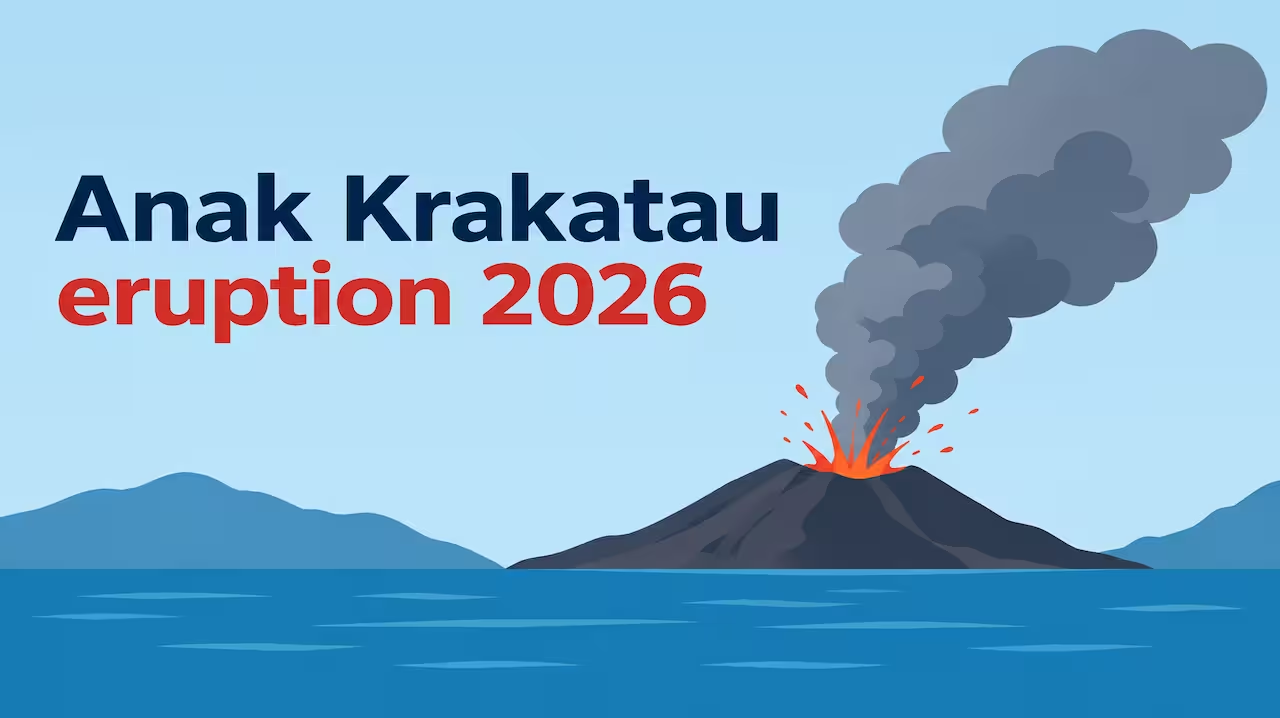
When a volcano sits between Java and Sumatra and starts sending ash high into the sky for more than a day, it does not remain a local story. In early September 2026, Anak Krakatau — the “child” of the old Krakatau — went through a continuous eruptive episode lasting about 25 hours. The ash cloud reached about 15,000 metres (50,000 feet) in some areas. Volcanic ash disrupted air travel, and operations at several airports on Java and Sumatra were temporarily affected. Thousands of flights were cancelled or delayed during the disruption.
People in nearby coastal areas also remembered 1883 and 2018 and asked the same question: could another tsunami happen?
That is why this is not only a news item. For UPSC, State PSC, CDS, NDA and school boards, this is a living example of static geography. Location, plate boundary, type of volcano, type of eruption, caldera, tsunami and the Ring of Fire all come together in one topic.
I treat current affairs like a door. The door this month is the Anak Krakatau eruption 2026. Behind it is the whole Krakatau story.
Why it is in the news
The long eruptive episode began late on 4 September 2026 and ended just after midnight on 6 September. Indonesia’s Geological Agency said the continuous episode lasted about 25 hours.
After that, Anak Krakatau returned to shorter Strombolian bursts — repeated explosions that send ash, volcanic fragments and sometimes lava upward, followed by pauses.
The ash cloud reached different heights in different directions. In some areas, it reached about 15,000 metres (50,000 feet). The volcanic ash caused serious problems for aviation, with several airports temporarily affected and thousands of flights cancelled or delayed.
The volcano remained at Level III (Alert), with a 3-kilometre danger zone around the crater.
Some videos shared online were actually old footage from the 2018 eruption. For exam notes, always check the date and prefer official updates over random social-media posts.
The 2026 event also brought attention back to the tsunami history of Krakatau. But an eruption does not automatically mean a tsunami. A major tsunami would require a significant displacement of seawater, such as a large volcanic collapse or landslide into the sea.
Where it sits on the map
Krakatau is not on Java and not on Sumatra. It stands in the Sunda Strait, the stretch of water between the two islands.
Jakarta lies to the east. Lampung is on the Sumatra side, while Banten is on the Java side.
The Sunda Strait is part of the Sunda volcanic arc, an area with strong tectonic activity. The Indo-Australian Plate is subducting beneath the Eurasian/Sunda region. As the descending plate releases water and other fluids, they help trigger melting in the mantle above it. Magma then rises and feeds volcanoes along the volcanic arc.
This is one major reason Indonesia has so many active volcanoes.
For an exam, remember:
Sunda Strait + Java + Sumatra + subduction
That simple combination is enough to locate Krakatau and explain why volcanoes occur there.
From dynamic news to static geography
Here is how I lock the topic.
| Dynamic — current event | Static — geography to remember |
|---|---|
| Anak Krakatau ash and flight disruption | Location in Sunda Strait |
| About 25-hour eruptive episode | Types of volcanic eruptions |
| Fear of another tsunami | 1883 collapse and 2018 flank collapse |
| “Child of Krakatau” growing again | Caldera and new volcanic cone |
| Ring of Fire in the headlines | Plate boundaries and subduction |
For a stronger exam answer, do not stop at “a volcano erupted in Indonesia.”
Connect the event with its location, plate boundary, volcano type, caldera, eruption style, and the important years 1883 and 2018.
That turns a current-affairs question into a proper geography answer.
The parent: Krakatau, August 1883
Before there was a child, there was the old Krakatau volcanic island. It had three main volcanic peaks: Perboewatan, Danan and Rakata.
In August 1883, Krakatau went through a massive explosive eruption. The eruption destroyed much of the volcanic island and produced a large caldera. Huge waves then travelled across the Sunda Strait.
More than 36,000 people died, and the great majority of these deaths were caused by the tsunamis rather than by lava.
The 1883 eruption is still an important case study of:
- explosive volcanism
- caldera formation
- volcanic collapse
- volcanogenic tsunami
- atmospheric effects from a huge volcanic eruption
The Volcanic Explosivity Index (VEI) for the 1883 eruption is commonly given as 6.
You do not need to memorise the entire VEI scale for a two-mark answer. Remember the important combination:
1883 → massive eruption → caldera → tsunami → more than 36,000 deaths
What is a caldera?
A caldera is a large depression formed when part of a volcano collapses after a major eruption and the underground magma system loses a large amount of material.
Think of a cake that sinks in the middle after its filling is removed. The centre becomes lower than the surrounding surface.
After the 1883 eruption, seawater filled much of the volcanic depression. Anak Krakatau later grew inside this wider volcanic area.
This is why the old Krakatau story is important for understanding the young Anak Krakatau.
The child: how Anak Krakatau was born
The sea over the 1883 caldera was not quiet forever.
After renewed volcanic activity in the 1920s, a new volcanic cone emerged above sea level in 1927. People named it Anak Krakatau, which means “Child of Krakatau.”
Since then, the young volcano has continued to build itself through repeated eruptions. Lava, ash, volcanic bombs and other broken volcanic material have added new layers to the cone.
In its early development, some eruptions involved magma coming into contact with seawater, producing phreatomagmatic activity. As the volcanic cone grew above the sea, other eruption styles became more common.

Anak Krakatau is generally described as a composite volcano or stratovolcano. It has been built from layers of lava and pyroclastic material and continues to change as new eruptions add material to the cone.
That last point is important because the shape of a young volcanic island can change quickly.
December 2018: why tsunami fear returned in 2026
In December 2018, a large part of the flank of Anak Krakatau collapsed into the sea. The landslide displaced seawater and generated a tsunami.
The waves reached coastal areas of Banten and Lampung, killing hundreds of people.
This was different from a typical earthquake-generated tsunami. There was no need for a major earthquake to suddenly lift or lower the ocean floor. Instead, the movement of volcanic material into the sea displaced the water.
So when ash rose for about 25 hours in September 2026, memories of 2018 naturally returned.
But an ash eruption does not automatically produce a tsunami.
A tsunami from a volcano generally requires a major disturbance of seawater, such as a large flank collapse, landslide or another major volcanic event.
For exam answers, keep these three ideas separate:
- Earthquake tsunami — sudden movement of the sea floor displaces seawater.
- 1883 Krakatau tsunami — the enormous volcanic eruption and collapse of the Krakatau system generated destructive waves.
- 2018 Anak Krakatau tsunami — a large flank collapse sent volcanic material into the sea and displaced seawater.
This distinction can make your answer much clearer.
What kind of volcano and what kind of eruption?
Krakatau belongs to a volcanic island arc created by subduction, and Anak Krakatau is a young composite volcanic cone.
Its eruptions are different from the huge lava outpourings associated with some basaltic fissure eruptions.
Anak Krakatau commonly shows Strombolian activity. Strombolian eruptions involve repeated explosive bursts from a volcanic vent. These bursts can throw volcanic bombs, ash and other material into the air, followed by pauses before another burst.
During the September 2026 event, the volcano experienced a much longer continuous eruptive episode. After that episode ended, Indonesian authorities reported that the activity returned to Strombolian characteristics.
Do not mix these eruption terms
This is an easy place to make mistakes in an exam.
- Hawaiian: usually gentle eruptions dominated by very fluid basaltic lava and lava fountains.
- Strombolian: repeated explosive bursts from a volcanic vent.
- Vulcanian: short, relatively violent explosive eruptions that can produce ash-rich clouds.
- Plinian: extremely powerful explosive eruptions that can produce very tall, sustained eruption columns.
- Fissure eruption: magma comes out through a long crack or fissure rather than mainly from one central vent.
For example, the Deccan Traps are associated with ancient large-scale flood-basalt volcanism involving extensive fissure eruptions. That is a very different volcanic setting from the young cone of Anak Krakatau.
So remember:
Anak Krakatau → composite cone → subduction zone → repeated explosive activity
Do not write that the 2026 eruption was a Deccan-style fissure eruption.
Why volcanic ash is a problem for aircraft
One of the biggest lessons from the 2026 eruption was the effect of volcanic ash on aviation.
Volcanic ash is not ordinary dust. It can contain tiny sharp particles of volcanic glass and minerals.
When aircraft fly through a dense volcanic ash cloud, the ash can damage or interfere with aircraft engines and other parts of the aircraft.
That is why airlines and aviation authorities take ash clouds seriously and may reroute, delay or cancel flights when volcanic ash enters important flight paths.
So if an exam asks about the main immediate impact of the September 2026 eruption, aviation disruption caused by volcanic ash is an important point to mention.
Hazards you should list
An active volcano can create several different hazards:
Ash in the air — can affect aircraft, eyes, breathing, roads and water supplies.
Volcanic bombs and rocks — large pieces of volcanic material can fall near the crater. This is one reason exclusion zones are important.
Lava — can destroy parts of the volcanic island, although lava is not the main hazard to distant cities such as Jakarta.
Volcanic gases — gases such as sulphur dioxide can irritate the eyes and respiratory system and can affect air quality.
Tsunami — possible if a major volcanic collapse, landslide or other large disturbance displaces seawater. An ash eruption alone does not automatically create a tsunami.
Lahars — mixtures of volcanic ash, rock and water can flow down volcanic slopes, particularly after heavy rainfall. The small size and marine setting of Anak Krakatau mean this hazard has to be considered in its own context.
For the September 2026 event, the major wider disruption was volcanic ash and its effect on aviation.
How I remember the whole family
I use one simple sentence:
Parent died in 1883, child appeared in 1927, child slipped in 2018, child coughed ash in 2026.
Then I pin four words:
- Where: Sunda Strait
- Why: Subduction
- What shape: Caldera + new volcanic cone
- What fear: Tsunami from major collapse or water displacement, not from every eruption
If the map is blank in the exam hall, I draw two large islands, a narrow sea between them, and a dot in the middle.

Those two islands are Java and Sumatra.
The dot is Krakatau.
Another easy trick is the name itself:
Anak = child
So if you forget what Anak Krakatau means, remember that it is the “Child of Krakatau.”
What a good exam answer looks like
2 marks
Anak Krakatau is an active volcanic cone in the Sunda Strait between Java and Sumatra. It developed after the 1883 Krakatau eruption and became active again in September 2026, producing a major ash cloud that disrupted air travel.
5 marks
Add:
- location in the Sunda Strait
- subduction and the Sunda volcanic arc
- composite/stratovolcanic nature
- Strombolian activity
- the 1883 eruption and tsunami
- the 2018 flank-collapse tsunami
- the 2026 Level III alert and exclusion zone
15 marks / essay
Start with the 2026 eruption.
Then move to:
Location → plate tectonics → 1883 eruption → caldera → birth of Anak Krakatau → 2018 flank collapse → tsunami mechanism → volcanic hazards → monitoring and aviation disruption
Finish by explaining why volcanic activity in Indonesia remains an important geographical and disaster-management topic.
Do not claim that the 2026 eruption killed tens of thousands of people.
Do not mix Krakatau with Barren Island unless the question specifically asks about Indian volcanoes. Barren Island is India’s active volcano in the Andaman region, while Krakatau is in Indonesia. They are both part of the broader tectonic setting of the Southeast Asian volcanic arc, but they are different volcanoes.
Small facts people mix up
- Krakatau and Krakatoa refer to the same volcanic island/system; “Krakatoa” is a common English form of the name.
- Anak Krakatau is the young volcanic cone that developed after the 1883 destruction of Krakatau.
- The 1883 disaster caused enormous tsunami losses, with more than 36,000 deaths.
- The 2018 tsunami was caused by a major flank collapse of Anak Krakatau into the sea.
- The 2026 eruption mainly caused disruption from volcanic ash, especially to aviation.
- Krakatau is in the Sunda Strait, between Java and Sumatra.
- It is part of the wider Indonesian volcanic arc and Ring of Fire.
- A volcanic eruption does not automatically produce a tsunami.
A simple four-date revision line
If you have only ten seconds before an exam, remember:
1883 → Krakatau destroyed and huge tsunami
1927 → Anak Krakatau emerged
2018 → flank collapse and tsunami
2026 → prolonged eruption and major ash disruption
That four-date chain gives you the basic story.
Conclusion
The Anak Krakatau eruption 2026 looked dramatic on satellite images, and it caused real disruption, especially because volcanic ash affected aviation.
But for a student, the biggest value of this event is what sits behind the headline.
One eruption can revise a whole geography chapter:
Sunda Strait → subduction → volcanic island arc → composite volcano → caldera → Anak Krakatau → volcanic ash → tsunami hazards
The 1883 eruption explains the old Krakatau. The 1927 emergence explains the birth of Anak Krakatau. The 2018 flank collapse explains why volcanic tsunamis are taken seriously. And the 2026 eruption shows that the young volcano is still active and changing.
I would keep the four-date chain on one page of my notes:
1883 — 1927 — 2018 — 2026
Then connect each date with one idea.
Mountains in the Sunda Strait will continue to change. The useful lesson for an exam is to understand why they change and how that connects current affairs with physical geography.
FAQs
Q1. Why was Anak Krakatau in the news in 2026?
A: It erupted for about 25 hours from 4 to 6 September 2026. Ash rose up to about 15,000 metres to the west, several airports closed for a time, and thousands of flights were disrupted. The alert stayed at Level III.
Q2. What is the difference between Krakatau and Anak Krakatau?
A: Krakatau is the old volcanic island that was largely destroyed in 1883, leaving a caldera. Anak Krakatau is the new cone that rose from that caldera from 1927 onward. The name means “child of Krakatau”.
Q3. Was the 2026 eruption like 1883?
A: No. 1883 was a giant caldera-forming blast with a deadly tsunami. 2026 was a strong but much smaller episode that later returned to Strombolian bursts. The main public impact was ash and air travel, not a mega-tsunami.
Q4. Why can this volcano cause a tsunami?
A: If a large part of the cone collapses into the sea, as in December 2018, the displaced water can flood nearby coasts. The 1883 waves came from a far bigger destruction of the island. Not every ash eruption creates those waves.
Q5. How should this be written in an exam?
A: Start with the 2026 eruption in the Sunda Strait, then link it to subduction, composite volcano, 1883 caldera, birth of Anak Krakatau in 1927, and the 2018 landslide tsunami. Add that Indonesia lies on an active plate margin.